
"Kith & Kin: People you are connected with, especially by family relationships"
"Kith & Kin: People you are connected with, especially by family relationships"

This page is a quiet space to honour the lives and legacies of family heroes—those who served, supported, endured, and remembered. Each story shared here began with a photo, a memory, or a tribute posted by our community on our Facebook page.
We’ve gathered these contributions to preserve them with care. Some are brief, some deeply personal—but all are part of the wider tapestry of courage and connection.
If you’d like to add your own story, we welcome you to do so on our Facebook article. Click the button below and enter your commemoration and/or a photograph in the comments. Whether it’s a name, a photo, or just a few words, it will be copied here with gratitude so that you and your family and friends can revisit time and time again.
Scotland’s Contribution to World War I and II: A Legacy of Courage and Resilience
From the trenches of the Western Front to the shipyards of the Clyde, Scotland’s imprint on the two World Wars is profound and enduring.
World War I: A Nation Mobilized
When Britain declared war on Germany in August 1914, Scotland responded with fervent patriotism. Over 500,000 Scots enlisted, a staggering figure given the population of just 4.8 million. The heavy industrial regions of Lanarkshire, Ayrshire, and Glasgow saw particularly high recruitment rates, driven by a mix of duty, peer pressure, and economic need.
• Scottish regiments like the Black Watch, Argyll and Sutherland Highlanders, and Cameron Highlanders were among the first to land in France.
• The Battle of Loos (1915) marked a tragic milestone: half the British battalions involved were Scottish, and casualties were devastating—over 700 from the 9th Black Watch alone.
• At home, shipbuilding and steel production surged to meet wartime demands, with the Clyde becoming a vital artery for naval power.
The war’s toll was immense: over 100,000 Scots died, and countless families were left grieving.
World War II: Industry and Resistance
By 1939, Scotland was once again thrust into the heart of conflict. This time, its industrial might was even more critical:
• Scottish shipyards produced warships and merchant vessels essential to the Allied supply chain.
• Engineering firms across Glasgow and Edinburgh manufactured tanks, aircraft components, and munitions.
• Scottish regiments fought valiantly across Europe, North Africa, and the Pacific, with many earning distinctions for their bravery.
The civilian cost was also high. German bombing raids targeted industrial hubs like Clydebank, causing widespread destruction and loss of life. Yet communities rallied, showing remarkable resilience.
Since 1945, Scottish men and women have taken part in conflicts such as Korea, the Falklands, the Gulf, Iraq, and Afghanistan. Today, we pay tribute not just to those who gave their lives, but also to those who returned and continued/continue to deal with the effects of war well beyond the end of the conflict. We appreciate all who are currently serving and hope for their safety.
Across Scotland, war memorials stand in quiet testimony. Each name is a story of kinship and courage. At Kith and Kin, we believe remembrance is not just about history—it’s about connection.
Whether you’re tracing a family tree, sharing a wartime letter, or simply pausing to reflect, you’re part of this living legacy.

In the early hours of New Year’s Day 1919, the Isle of Lewis was poised for celebration. After four years of war, hundreds of island men were finally coming home. Families had prepared fires, food, and warm embraces. But what arrived instead was silence, broken only by the sound of waves and grief.
The HMY Iolaire—meaning “Eagle” in Gaelic—was a Royal Navy yacht tasked with ferrying servicemen from Kyle of Lochalsh to Stornoway. She was overcrowded, carrying nearly 300 men, most of them from Lewis and Harris. As she approached Stornoway harbour in the early hours of new year’s morning, in poor visibility and rough seas, the vessel struck the Beasts of Holm—a notorious reef just yards from shore. Within minutes, she was wrecked.
Of the 280 aboard, 201 drowned. Many were within sight of land. Some clung to the rigging for hours. Others were swept away as they tried to swim. Only 79 survived, and many of those were left with lifelong trauma. The tragedy was so vast that it touched nearly every household in Lewis. One woman lost her husband, two brothers, and three cousins. Another, pregnant and waiting at the harbour, collapsed when she learned her husband had drowned.
The scale of the loss was staggering. Lewis had already lost over 1,000 men in the war—more than any other British community per capita. The Iolaire added a final, cruel blow. The island ran out of coffins. The dead were laid out in the Drill Hall, and funeral processions stretched for days. The Stornoway Gazette called it “the blackest day in the history of the island.”
What makes the Iolaire tragedy so haunting is its bitter irony. These men had survived the war—only to die within sight of home. The shipwreck became a symbol of fate’s cruelty, and for decades, it was barely spoken of. Survivors were reluctant to share their stories. Families buried their grief in silence. The trauma was too deep, too raw.
The official inquiry offered little comfort. Held behind closed doors, it concluded that the ship had veered off course, possibly due to navigational error. Some speculated that the crew had been drinking. Others blamed poor charts or the lack of a local pilot. But no one was held accountable. The silence continued.
And yet, the Iolaire is not just a story of devastation. It is a story of resilience. The people of Lewis and Harris carried on. They rebuilt their lives, raised children, and kept the memory alive in quiet ways. Gaelic songs, poems, and oral histories preserved the pain and honoured the dead. In recent years, that silence has begun to lift. Memorials have been erected. Books and documentaries have explored the tragedy. Artists and descendants have reclaimed the story, not as a wound, but as a legacy.
Among the survivors was John F. MacLeod of Ness, whose bravery saved dozens. As chaos unfolded, MacLeod grabbed a rope, handed one end to a man onboard, and prepared to swim ashore. The sea was violent, the waves relentless. He was pushed back repeatedly, further from shore than when he began. But he persisted, keeping afloat and timing his effort with the crest of a wave. Eventually, he was thrown onto the rocks and managed to cling on. That rope became a lifeline—about 40 men used it to reach safety.
MacLeod’s feat was extraordinary. The water was freezing. The wreck site was exposed to gale-force winds. Experienced swimmers could not survive unaided. Yet his determination and timing allowed him to establish the only viable escape route. Survivors later described him as the reason they lived. His act is now commemorated in sculpture near the memorial at Holm—a rope cast in bronze.
To reflect on the Iolaire is to confront the fragility of peace, the cruelty of fate, and the enduring strength of remembrance. It reminds us that history is not just dates and facts—it is grief carried in silence, and love that outlasts loss.
The photograph is John Finlay MacLeod.

This is a story of a family reconnecting with a long-lost close relative that is described in a book I acquired recently from Lanarkshire Family History Society, called ‘Harthill – The Village That Went to War’. The village of Harthill in North Lanarkshire is where I live and was brought up.
The book remembers those who served during World War 1 who had some connection to the village of Harthill. There are so many great tributes in this book but one in particular has stood out to me. Every so often you read or hear something that just seems to resonate with you. In this line of work this happens regularly. I always find myself compelled to carry out some further research in these cases and here is the summary of what I personally collected and what I read in the book. I hope you find the story of Sgt David Alexander Kitto as interesting as I did.
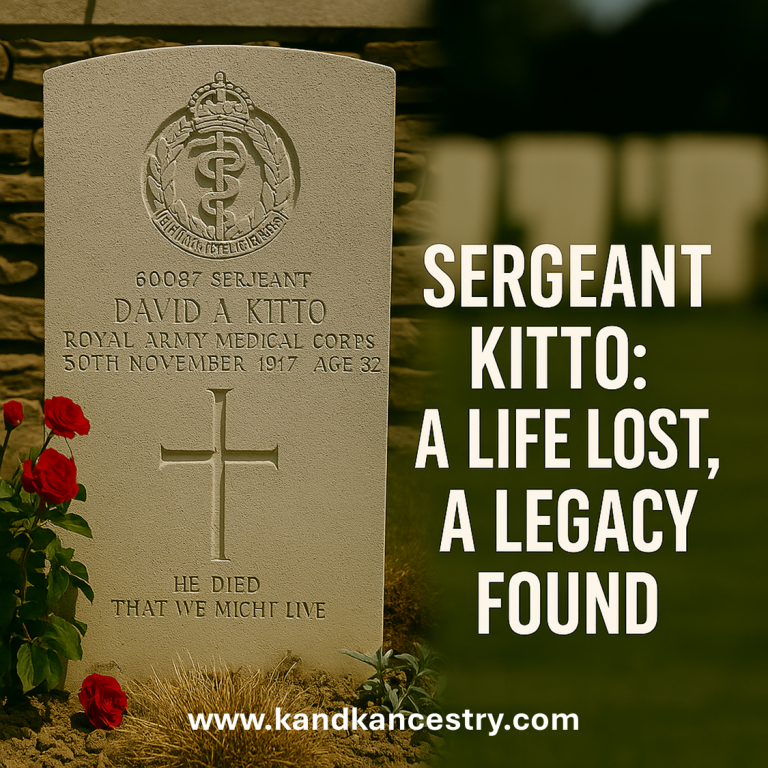
He was born on 26th September 1885 at Braefoot, Carnoustie, the son of Thomas Kitto and Margaret Shands. He was the second oldest of a family of six. Although he started out his working life as an apprentice plumber (1901 census), he went on to gain a BSc in Chemistry from St Andrews University and found his way to Harthill, Lanarkshire where he became a teacher of science at Harthill Public School. In June 1915 he joined the Royal Army Medical Corps.
He met Isabella MacLure at teacher training college, and he took a short period of leave to marry her on 28th October 1915 in Dundee. Isabella was also a teacher at Harthill but returned to Arbroath and became a well-known teacher at Arbroath Primary School. She never remarried and died on 25th August 1979 at the age of 88 years.
David was promoted to Sergeant and in May 1916 he was sent to France. In November 1917 he was serving with the 37th Field Ambulance and was part of the British offensive known as the Battle of Cambrai which began on 20th November. Cambrai was a British attempt to take advantage of a perceived weakness in the German Hindenburg line. It was the first time tanks were used to spearhead the attack rather than the traditional artillery. The British attacked on a six-mile front to the west of the town, achieving initial success. However, they were unable to dislodge German artillery and infantry from the hills dominating the advance and enemy reinforcements, which were rushed to the area mounted a counterattack on 30th November. During the first day of the counterattack David was killed by a shell at Bourlon Wood. He was 32 years old. His body was not recovered, and his family were left unaware of his whereabouts. In the end the battle resulted in 80,000 German and 42,000 British casualties. David’s name was listed among the missing on the memorial at Cambrai.
In early 1990 the remains of RAMC shoulder flashes, a razor, a watch and a pen knife were ploughed up by farmers near the village of Villers-Plouich, near Cambrai. The farmers contacted the authorities, and permission was granted for further excavation. Human remains were discovered and following extensive research, the remains were found to be David’s. Although his wife was deceased, his brother-in-law, Adam MacLure, aged 90 years was located and his family helped with the arrangements for the funeral. The funeral took place on Friday 11th June 1993 at Terlinethun British Cemetery, near Wimille in the Pas-de-Calais region. The funeral was held according to the rites of the Church of Scotland and Sergeant Kitto’s regiment provided the bearer and saluting party, all the men coming from the 2nd Armoured Field Ambulance, RAMC, based in Osnabruck, Germany. Civil representatives of the British and French governments were present as he was buried with full military honours.
David’s nephew, Neil MacLure said
“David Kitto was thought of often in our home. We were very much aware of the fact that he had died in the first world war at a place unknown and that no trace of him has ever been found. As children, we came with our father often to France and we visited many war cemeteries looking for a trace of him. Today is very much the closing chapter”.
First published in the 'Past in a Flash' page of the website on 9th July 2025.
My great uncle, Thomas McKechnie, served with the Royal Scots in the 52nd Division during WWI. In 1917, they were stationed in the Middle East, tasked with defending the Suez Canal and pushing back Turkish forces. After being held in reserve for the 1st Battle of Gaza, they faced devastating losses in the 2nd Battle that April—over 1300 casualties from their division alone. Tom was wounded in the head on 19 May and passed away a month later in hospital in Cairo. He now rests at Cairo War Memorial Cemetery. Every story remembered.
Submitted by Ian Quigley

We need your consent to load the translations
We use a third-party service to translate the website content that may collect data about your activity. Please review the details in the privacy policy and accept the service to view the translations.