
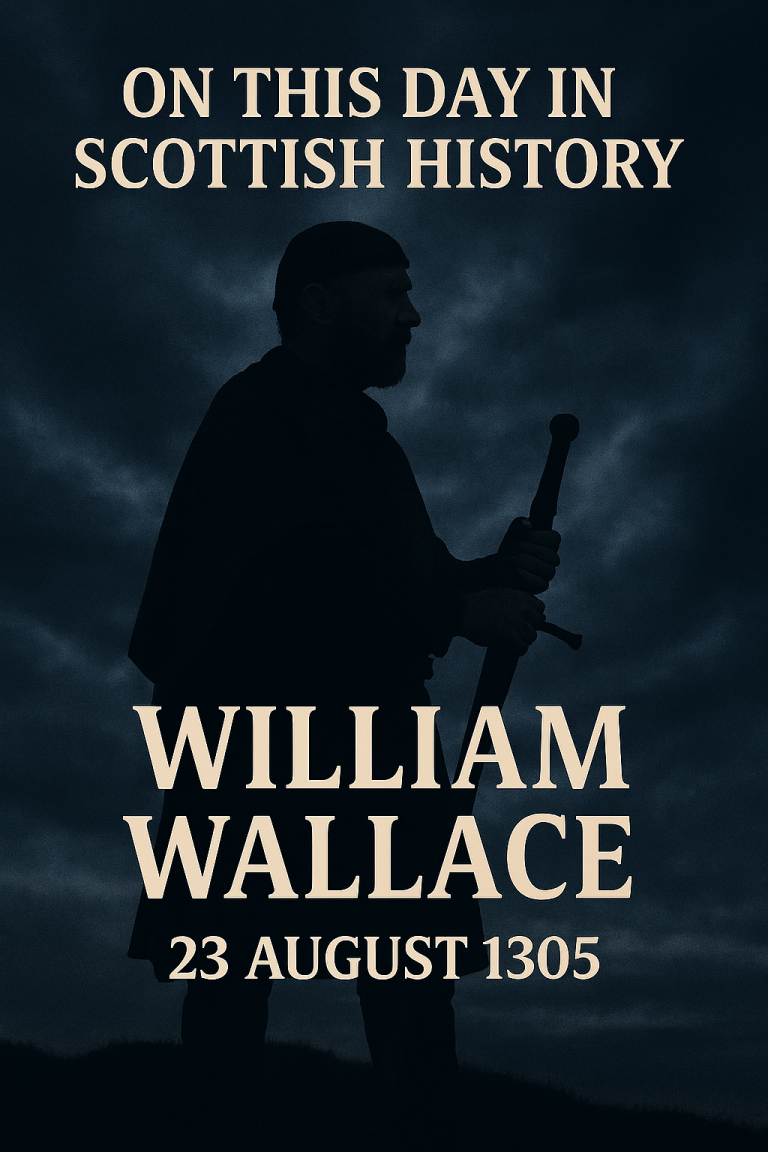
William Wallace: Scotland’s Enduring Symbol of Freedom
Originally published 23 August 2025
ON THIS DAY….23RD AUGUST 1305
Today we remember Sir William Wallace, executed in London on this day in 1305. His death was brutal—hanged, drawn, and quartered—but his legacy endures as one of Scotland’s most powerful symbols of resistance, courage, and conviction.
Born around 1270, likely in Elderslie, Renfrewshire, Wallace came from the lesser nobility. His father, believed to be Sir Malcolm Wallace, held land but wielded little political influence. Wallace likely received a Church-based education, learning Latin and law, and trained in the martial skills expected of a young landowner. Though not a high noble, he was deeply rooted in the land and values of his people.
Wallace’s rise began in 1296, when King Edward I of England deposed Scotland’s King John Balliol and declared himself overlord. In response, Wallace led a band of rebels, famously burning Lanark and killing its English sheriff. His campaign grew rapidly—he drove out English officials from Scone, struck at garrisons between the Forth and Tay, and joined forces with Sir William Douglas.
His most iconic moment came at the Battle of Stirling Bridge in September 1297. Wallace and Andrew Moray, commanding a vastly outnumbered Scottish force, used the narrow bridge to their advantage and defeated the English. This victory electrified the nation. Wallace was named Guardian of Scotland, a title he held until his defeat at Falkirk in 1298, where English longbowmen proved devastating.
Despite the loss, Wallace continued his resistance. He travelled abroad—possibly to France—seeking support for Scotland’s cause. In August 1305, he was betrayed and captured near Glasgow, handed over to Edward I, and taken to London. At his trial, Wallace famously declared that he was not a traitor, for he had never sworn allegiance to the English king.
His execution was meant to crush the spirit of rebellion. Instead, it forged a legend.
Completed in 1869, the Wallace Monument stands atop Abbey Craig in Stirling, where William Wallace is said to have watched the English army before the Battle of Stirling Bridge. It was funded by tens of thousands of Scots—ordinary people, not nobles—who wanted to honour Wallace’s fight for freedom.
Designed in Victorian Gothic style by architect John Thomas Rochead, the 220-foot sandstone tower houses Wallace’s legendary sword. From its crown-shaped viewing gallery, visitors can see the very landscape where Wallace once stood.