The West Highland Line: Scotland’s Most Soul-Stirring Railway Journey
Originally published 7 August 2026
There are railway journeys that are scenic, and then there are railway journeys that feel like stepping into the very heart of a country. The West Highland Line belongs firmly in the second category. Often described as one of the greatest rail routes in the world, it is a line where engineering ambition meets raw Highland wilderness, creating a journey that feels both timeless and deeply Scottish.
A Railway Built Against the Odds
Opened in stages between 1894 and 1901, the West Highland Line was carved through some of the most challenging terrain in Britain: deep glens, steep mountainsides, boggy moorland, and remote coastal fringes. Engineers battled weather, isolation, and geography to create a railway that connected Highland communities to the wider world.
A defining moment came on 7 August 1894, when the first train steamed into Fort William. After years of construction across unforgiving landscape, that arrival marked the town’s long‑awaited link to the Scottish rail network. It was a transformational day — one that opened Fort William to commerce, tourism, and new opportunities, and paved the way for the later extension to Mallaig.
Even today, the line feels like a triumph of determination, a reminder of an era when railways were lifelines rather than luxuries.
From Glasgow to the Edge of the Atlantic
The journey begins in Glasgow Queen Street, but the city quickly falls away. Within minutes, the train is threading through the wooded banks of Loch Lomond, climbing steadily into the Highlands.
Rannoch Moor: Scotland’s Great Wilderness
One of the most unforgettable stretches is Rannoch Moor, a vast, treeless expanse of peat bog and shimmering lochans. The railway floats across it on a “floating trackbed” — thousands of tons of earth laid on the bog to prevent the line from sinking. With no road access and no settlements, it offers a rare sense of true wilderness.
Corrour: Remote and Iconic
Next comes Corrour Station, Britain’s highest mainline station and famously remote. Known to many from Trainspotting, its real magic lies in its isolation. Step off the train and you’re surrounded by mountains with no roads for miles, a reminder of how bold the railway’s builders had to be.
Fort William and Ben Nevis
Descending from the moor, the train rolls into Fort William, the outdoor capital of Scotland. Ben Nevis towers overhead, and the town marks the gateway to the final, most iconic stretch of the line — the extension that would not exist without that first historic arrival in 1894.
The Jacobite Route: A Journey Through Film History
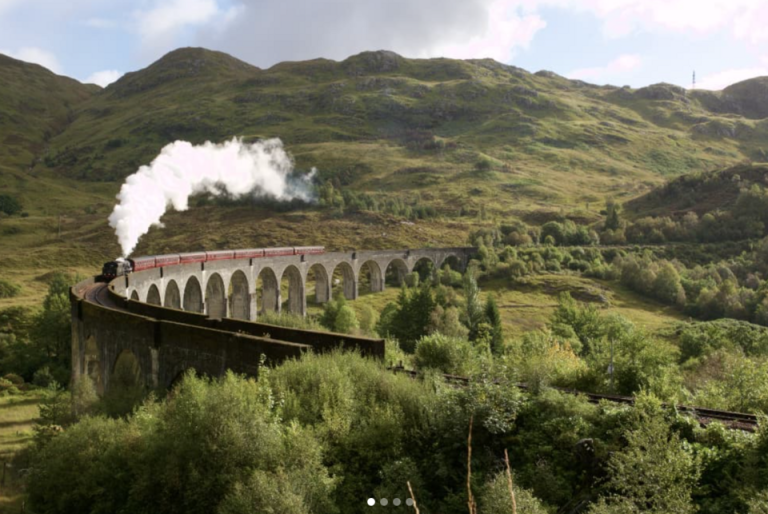
From Fort William to Mallaig, the line becomes almost cinematic. This is the route of the Jacobite Steam Train, made famous worldwide by the Harry Potter films.
The Glenfinnan Viaduct
The star of the show is the Glenfinnan Viaduct, a sweeping 21‑arch concrete masterpiece that curves across the valley with breathtaking elegance. As the train crosses, you can look down to Loch Shiel, where Bonnie Prince Charlie raised his standard in 1745. It’s a moment where Scottish history and Hollywood spectacle meet.
Arisaig, Morar, and the Silver Sands
Beyond Glenfinnan, the line hugs the coast, passing Arisaig and the Silver Sands of Morar — beaches so white and water so turquoise they look almost tropical.
Mallaig: Gateway to the Isles
The journey ends at Mallaig, a busy fishing port and ferry hub. From here, travellers can sail to Skye, the Small Isles, or simply enjoy fish and chips overlooking the harbour.
The West Highland Line is more than scenery. It’s a story — of engineering ambition, Highland resilience, and landscapes that have shaped Scotland’s identity for centuries. It offers remoteness, history, cinematic drama, and a reminder of Scotland’s wild heart.
And in a world that moves too fast, there’s something grounding about watching the mountains roll by from the window of a train that has carried generations before you — ever since that first locomotive arrived in Fort William on 7 August 1894, changing Highland travel forever.