
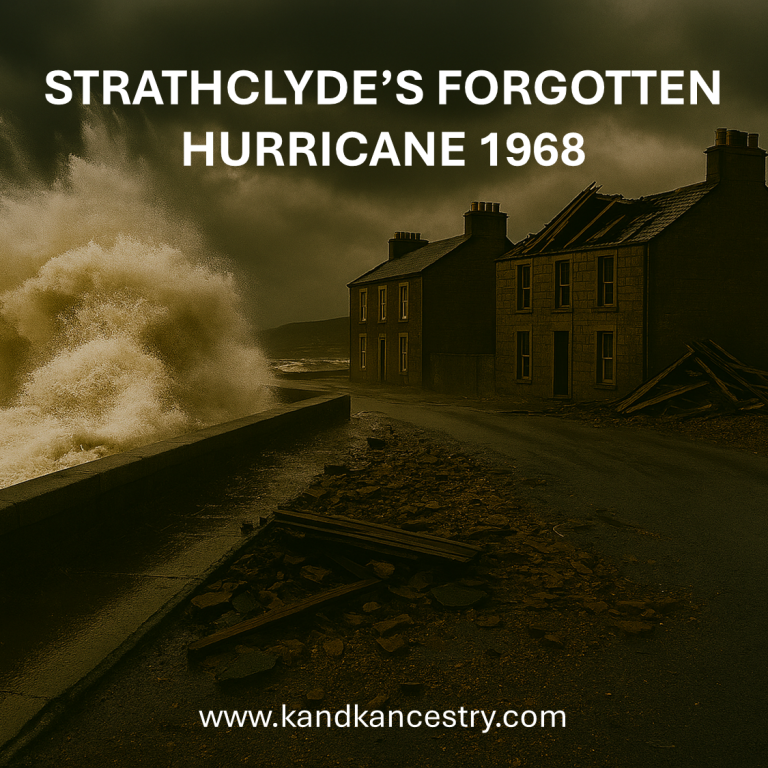
The Night the Wind Roared: Strathclyde’s Forgotten Hurricane of 1968
Originally published 15 January 2026
On the night of 15 January 1968, as families across Strathclyde settled into what felt like an ordinary winter evening, a storm of extraordinary ferocity was racing across the Atlantic. By dawn, the region would awaken to scenes of devastation not witnessed since wartime. Roofs were gone, streets were blocked by fallen masonry, and entire communities were left stunned by the scale of the destruction.
Though technically an extratropical cyclone, the event became known locally as the “1968 Hurricane.” With gusts reaching 134 mph, it remains one of the most violent storms ever to strike Scotland.
A Storm That Grew in the DarkMeteorologists later traced the storm’s origins to a cold front near Bermuda on 13 January. Within two days, the system deepened explosively, dropping around 50 millibars as it accelerated toward the UK. Scotland had no modern warning systems, no mobile alerts, and no real-time forecasts. Many people went to bed unaware that hurricane‑force winds were only hours away.
By the early hours of 16 January, the storm slammed into the Central Belt with catastrophic force.
Strathclyde at the Centre of the Chaos
Strathclyde bore the brunt of the storm. Glasgow, Renfrewshire, Dunbartonshire, and the Clyde coast were hit hardest, with widespread damage to homes, public buildings, and infrastructure.
Glasgow: A City Under Siege
Glasgow suffered some of the worst destruction.
More than 300 homes were destroyed and tens of thousands damaged.
Chimney stacks collapsed through roofs, crushing bedrooms and stairwells.
High‑rise flats swayed so violently that residents fled into the streets.
Emergency services were overwhelmed, describing the situation as “absolute havoc.”
The storm exposed the fragility of Glasgow’s post‑war housing stock, particularly older tenements already weakened by age and poor maintenance.
Renfrewshire and the Clyde Coast
In Paisley, the great bell of St James’s Church rang uncontrollably through the night, an eerie soundtrack to the chaos. Across Renfrewshire, cars were crushed by falling masonry, trees were uprooted, and power lines were torn down. Near Greenock, three crew members of a dredger died when their vessel capsized in the Clyde.
Dunbartonshire
One of the storm’s most poignant tragedies occurred in Bonhill, where a man driving his wife to hospital was killed when a falling tree crushed their car. His wife survived and later gave birth, a story that became symbolic of both loss and resilience.
Lives Lost and Communities Shaken
The storm claimed 20 lives across Scotland, with hundreds more injured. Around 1,800 people were left homeless, many forced to seek temporary shelter in schools, church halls, and community centres.
The scale of the destruction was so severe that troops were deployed from Edinburgh to assist with rescue and recovery. Parliament described the event as “a disaster on a national scale,” acknowledging that Scotland could not manage the aftermath alone.
Picking Up the Pieces
In the days that followed, Strathclyde became a patchwork of tarpaulins as emergency crews and volunteers worked to secure roofs and clear debris. The storm felled thousands of hectares of forest, leaving hillsides bare and altering landscapes for decades.
Financial assistance was issued to help families repair their homes, but many struggled for months. For some, the emotional impact lasted far longer than the physical damage.
Why the 1968 Hurricane Still Matters
Despite its severity, the 1968 storm has faded from public memory. Yet it remains a defining moment in Strathclyde’s modern history:
It exposed weaknesses in housing conditions and building standards.
It reshaped emergency planning and weather forecasting in Scotland.
It left behind stories of courage, neighbourliness, and community resilience.
A Legacy Written in Wind
The 1968 hurricane was more than a weather event. It was a night when Strathclyde was tested, and when its people showed extraordinary resilience. More than half a century later, its legacy endures in the memories of those who lived through it and in the lessons it left behind.