
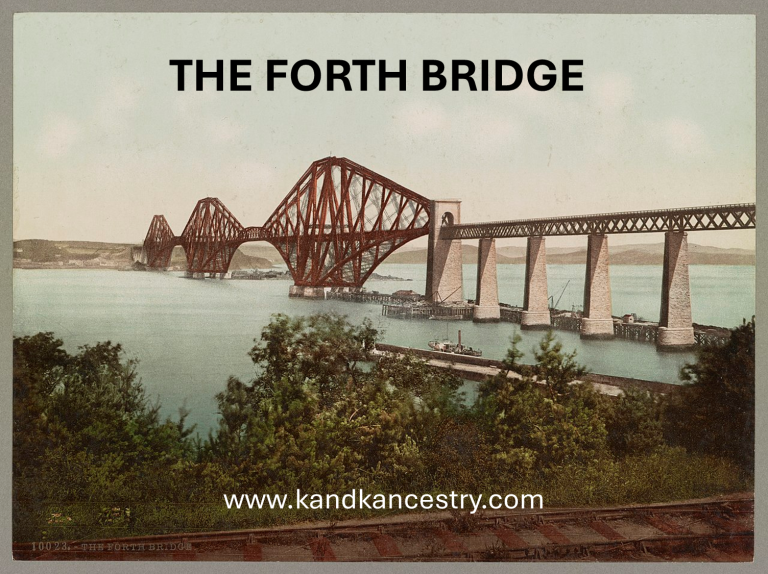
The Forth Bridge: Scotland’s Monument of Iron, Ingenuity and Endurance
Originally published 21 January 2026
Few structures capture the spirit of Scottish engineering quite like the Forth Bridge — the great red cantilever that strides across the Firth of Forth between South and North Queensferry. Completed in 1890 and still carrying up to 200 trains a day, it remains one of the most recognisable symbols of Scotland’s industrial confidence and creative ambition.
A Vision Forged in IronBy the late 19th century, Scotland needed a reliable rail link between Edinburgh and the north. Ferries had served for centuries, but the demands of industry, trade, and travel required something bolder. Engineers Sir John Fowler and Sir Benjamin Baker answered that call with a design unlike anything attempted in Britain before: a massive steel cantilever bridge, stretching 2,467 metres (8,094 ft) across the estuary.
When it opened on 4 March 1890, it boasted the longest single cantilever span in the world — a title it held until 1919. Even today, its twin spans of 521 metres remain the second longest on the planet.
Building the ImpossibleConstruction began in 1882, employing thousands of workers known collectively as the Briggers. Their labour was dangerous, often carried out high above the water or deep within caissons sunk into the riverbed. At least 73 men and boys lost their lives during the project, the youngest just thirteen years old.
The Briggers represented a global workforce: Scots, English, Irish, Italians, French, Belgians, Austrians, and Germans all contributed to the effort. Their skills ranged from riveting and rigging to masonry, diving, and hydraulic engineering — a testament to the complexity of Victorian mega‑projects.
A Moment of Proof: 21 January 1890One of the most dramatic moments in the bridge’s story came on this day, the 21st January 1890, during the final series of load‑tests. To demonstrate the strength and stability of the new cantilever design, engineers sent two full trains across the bridge at the same time — a symbolic and very public display of confidence.
Crowds gathered along the shores of North and South Queensferry to watch the spectacle. The sight of twin locomotives moving steadily across the great red spans reassured the public that the structure was not only bold but safe. Newspapers of the day described the test as a triumph, marking the moment the bridge truly proved itself.
Why the Cantilever Design MatteredThe Forth Bridge’s distinctive triangular frames aren’t just iconic — they’re ingenious.
Cantilevers balance forces through compression and tension, allowing the bridge to span vast distances without needing piers in deep, fast‑moving water. This made it ideal for the Firth of Forth, where tides and currents posed enormous challenges.
Its statistics still impress:• 361 ft (110 m) high at its tallest point• 150 ft (46 m) clearance for ships below• 53,000 tonnes of steel• A design built to withstand fierce winds and the weight of heavy rail traffic
A Living World Heritage SiteIn 2015, UNESCO recognised the Forth Bridge as a World Heritage Site, praising it as “a masterpiece of creative genius” and a defining achievement of the Industrial Revolution. It stands today not just as infrastructure, but as a cultural landmark — a reminder of the era when Scotland helped shape the modern world.
For travellers, photographers, and heritage lovers, the bridge remains a must‑see. Whether viewed from the cobbled streets of South Queensferry or from the water on a boat tour, its scale and elegance never fail to inspire.
A Bridge That Belongs to the PeopleMore than 130 years after its opening, the Forth Bridge continues to carry the lifeblood of Scotland’s rail network. But it also carries stories — of workers who risked everything, of communities connected, and of a nation whose engineering ambition still echoes in steel.It is, quite simply, a Scottish icon: bold, enduring, and unmistakably ours.