
The Burrell Collection: Glasgow’s Gift to the World
First published: 21 October 2025
On this day in 1983, the building designed to house the Burrell Collection in Glasgow’s Pollok Park was opened by Queen Elizabeth II.
Tucked into the woodlands of Pollok Country Park, the Burrell Collection is one of Glasgow’s most beloved cultural landmarks—a museum where global heritage meets architectural grace, and where the spirit of stewardship lives on in every gallery.
Its story begins with Sir William Burrell (1861–1958), a visionary Glaswegian shipping magnate whose passion for art spanned seven decades. Having built one of Britain’s most successful cargo fleets, Burrell retired early to pursue collecting with extraordinary care. His eye was drawn to medieval tapestries, Chinese ceramics, Islamic glass and French Impressionist paintings—works that spoke of craftsmanship, cultural exchange and emotional depth.
In 1944, he and Lady Constance Burrell gifted over 6,000 pieces to the city of Glasgow, along with funds to build a gallery that would protect and share them. His only stipulation was that the museum should be housed away from city pollution, in a setting that honoured the art’s fragility and spirit.
That vision came to life in 1983, when Queen Elizabeth II formally opened the Burrell Collection’s purpose-built home—a modernist marvel designed by Barry Gasson and Brit Andresen. With its clean lines, natural materials and expansive glass walls, the building was celebrated for its harmony with the surrounding parkland and its pioneering approach to museum design. It remains one of the few Category A-listed post-war buildings in Scotland.
Following a major refurbishment completed in 2022, the museum reopened with renewed accessibility, sustainability and curatorial flexibility—earning the Art Fund Museum of the Year award in 2023. Today, the Burrell Collection invites slow looking, quiet reflection and a sense of shared stewardship. It is not just a gallery—it is a legacy of generosity, vision and belonging.
Among its treasures:
- Rodin’s The Thinker, one of fourteen bronzes gifted by Burrell.
- Degas’ Portrait of Edmond Duranty, capturing the writer’s intensity.
- A rare Ming Dynasty Meiping Vase from the Hongwu period.
- The Wagner Garden Carpet, one of the world’s oldest surviving Persian garden carpets.
- A Limoges Reliquary Casket from the early 1200s.
- A fragment of an Assyrian Royal Attendant from Nimrud.
- A 16th-century tapestry depicting a falcon and heron locked in dramatic flight.
The museum’s architecture even integrates historical fragments—such as a 16th-century doorway—into its modernist frame, echoing Burrell’s love of Gothic domesticity and layered storytelling.
For those who cherish heritage, craftsmanship and quiet generosity, the Burrell Collection is more than a museum. It is a place where memory is honoured, where art breathes and where the past is offered as a gift to the present.
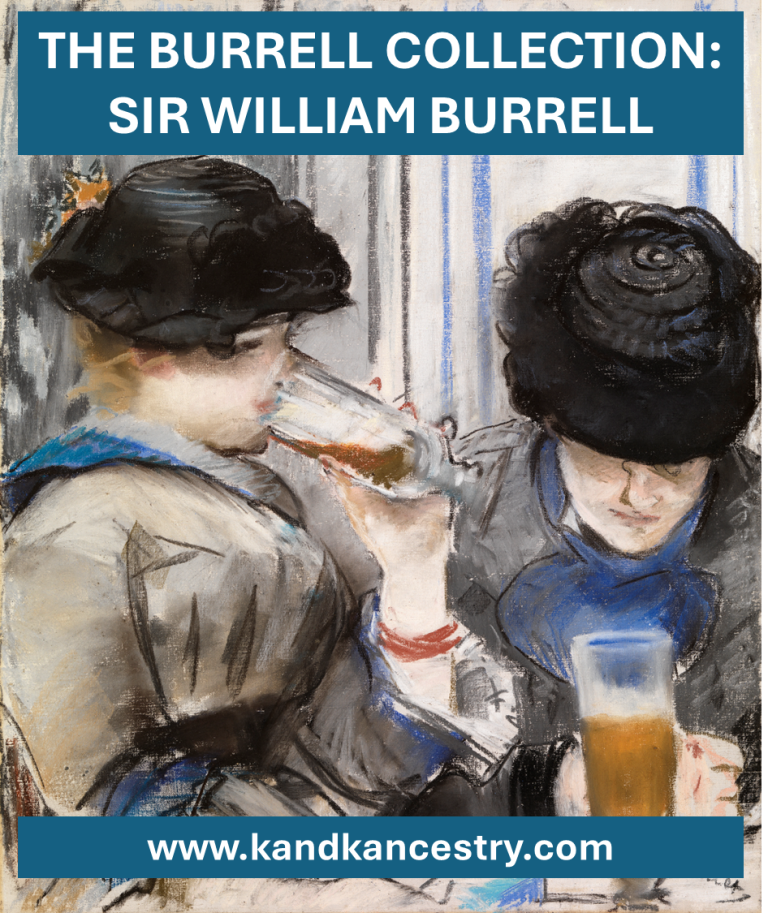
Image: “Two Women Drinking Bocks” by Édouard Manet. Public domain, via Wikimedia Commons.