The Battle of Largs: The Day Scotland Faced Norway
On the Ayrshire coast, the Battle of Largs is remembered as the day Scotland turned back a Norwegian invasion. The real story is less tidy—and more interesting. The fighting on 2 October 1263 was confused, limited and probably indecisive. Yet the campaign around it helped change who ruled the islands off Scotland’s western shore.
Scotland, Norway and the western isles
To understand the battle, we have to look west. The Hebrides and the Isle of Man belonged to a Norse political world that had developed over centuries. By the thirteenth century, the Scottish crown was pressing to bring these islands under its authority. Alexander III of Scotland tried to acquire them from Håkon IV of Norway, but Håkon would not surrender his claim.
These were not empty territories waiting to be claimed. Island rulers and communities had their own interests, loyalties and rivalries, while sea routes connected the Hebrides to Norway, Ireland and the Clyde. Royal titles drawn on a map could not fully describe who held power locally. The struggle was therefore about people and trading networks as well as distant kings.
Storm and battle on the Ayrshire coast
In the summer of 1263, the Norwegian king sailed west with a large fleet. After gathering support in the islands, his forces entered the Firth of Clyde. There were raids and negotiations, while the campaigning season slipped towards autumn. Scottish delay may have been deliberate, although historians should be cautious about turning clever strategy into certainty when the evidence is limited.
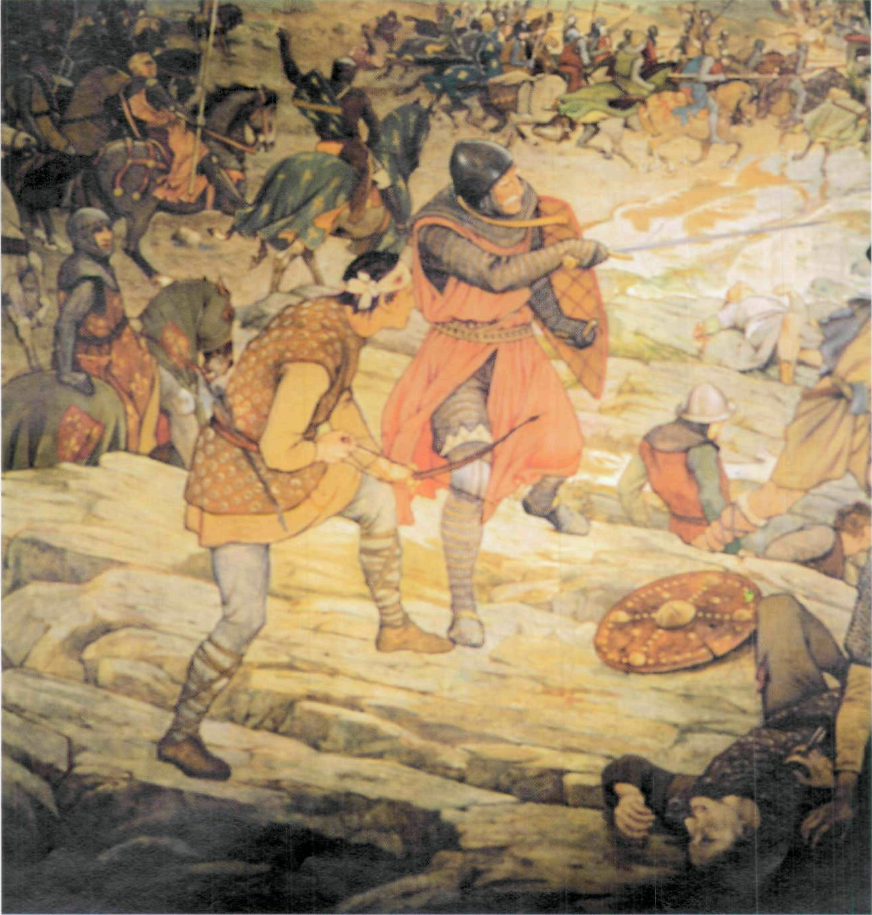
Then the weather intervened. A fierce storm struck the Norwegian fleet off Largs, driving vessels ashore and scattering supplies. Men landed to recover ships and equipment. Scottish forces approached, and on 2 October fighting broke out along the beach and nearby slopes. The surviving accounts do not give us a clean, modern battle report. The fullest narrative comes from Hákonar saga Hákonarsonar, a Norwegian source written soon afterwards and drawing on testimony close to the expedition.
The Scots pressed the Norsemen, but the Norwegian force was not destroyed. Reinforcements reached the shore, and the fighting eventually faded. Claims of enormous armies and dramatic casualty totals are not secure. Largs was closer to a hard-fought skirmish than the crushing victory imagined in later patriotic retellings.
The treaty that changed the islands
What mattered was what came next. Håkon withdrew north as winter approached and died in Orkney that December. Scottish forces then increased pressure on the islands. In 1266, the Treaty of Perth brought the conflict to a formal close. Norway recognised Scottish rule over the Hebrides and the Isle of Man in return for payment, while Scotland accepted Norwegian sovereignty over Orkney and Shetland.
That settlement shifted Scotland’s centre of power westwards, but it did not erase the islands’ Norse past. Place-names, archaeology, family traditions and seafaring links still reveal a region shaped by Gaelic and Scandinavian worlds together. The people of the Hebrides did not suddenly become culturally different because two kings had made peace.
Beyond the Viking legend
The date also matters. Calling Håkon and his men simply ‘Vikings’ is convenient, but by 1263 Norway was a Christian medieval kingdom with organised government and diplomacy. The popular label can connect the story to an earlier Norse age, yet it should not turn every Norwegian into the raider of a saga or obscure the mixed society of the western seaboard.
Largs therefore deserves to be remembered, just not as a simple tale of one side winning and the other fleeing. The battle itself settled little. The failed Norwegian campaign, Håkon’s death and the diplomacy that followed settled far more.
Today, the Pencil monument stands near the shore and the town’s Viking festival keeps the story visible. Behind the pageantry lies a useful lesson: history often turns not on a single heroic clash, but on weather, timing, negotiation and the uncertain consequences of an unfinished fight.