The Battle of Culloden: Politics, Power and the Fall of the Jacobite Cause
Originally published 16 April 2026
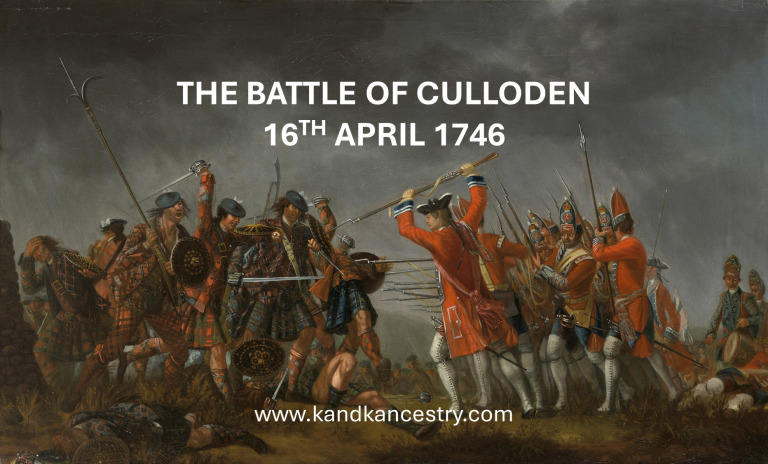
On April 16, 1746, the Battle of Culloden brought a swift and brutal end to the Jacobite Rising of 1745. Fought on a bleak moor near Inverness, the battle lasted less than an hour, yet its consequences reshaped the political and cultural fabric of Britain—particularly in the Scottish Highlands.
To understand Culloden, it is essential to look beyond the battlefield and into the turbulent political climate of 18th-century Britain. The conflict was rooted in a dynastic struggle that dated back to the Glorious Revolution of 1688, when James II was overthrown and replaced by William and Mary. This event established parliamentary supremacy and solidified Protestant rule, but it also left a lingering faction—known as the Jacobites—who remained loyal to the exiled Stuart dynasty.
By the mid-1700s, Britain was ruled by the Hanoverian monarchy under George II. The Hanoverians were supported by Parliament and much of the political establishment, particularly in England and the Lowlands of Scotland. However, in the Highlands and among certain Catholic and Episcopalian groups, sympathy for the Stuarts remained strong. These divisions were not just about loyalty to a monarch—they were tied to religion, regional identity, and resistance to centralized political control from London.
The Jacobite Rising of 1745 began when Charles Edward Stuart, the grandson of James II, landed in Scotland with the aim of reclaiming the throne. His campaign initially succeeded in rallying Highland clans and capitalizing on dissatisfaction with the British government. Early victories, including the capture of Edinburgh and a bold march into England, exposed the vulnerability of the Hanoverian regime.
Yet the rising also revealed deep political fractures. Many potential English supporters hesitated to join Charles, wary of both the risks and the prospect of a Catholic monarch.
Meanwhile, the British government, already engaged in the War of the Austrian Succession, recognized the uprising as a serious internal threat. The Jacobite cause was not merely a rebellion—it was seen as a possible gateway for foreign intervention, particularly from France, which supported the Stuarts as a means of weakening Britain.
As the Jacobite army retreated back into Scotland in early 1746, their position became increasingly precarious. Supplies dwindled, morale declined, and divisions emerged within their leadership. In contrast, government forces, commanded by the Duke of Cumberland, were well-equipped, disciplined, and politically unified in their goal of crushing the rebellion.
Culloden Moor proved to be a disastrous choice for the Jacobites. The open, marshy terrain neutralized their traditional Highland charge, leaving them exposed to devastating artillery fire. When the battle commenced, confusion and exhaustion hampered their advance. Within an hour, the Jacobite forces were overwhelmed and driven into retreat.
The political consequences of the defeat were severe and far-reaching. The British government moved swiftly to eliminate any remaining support for the Jacobite cause. A series of repressive measures targeted the Highlands, dismantling the clan system that had long formed the backbone of Jacobite resistance. Laws were enacted to ban traditional dress, disarm the population, and suppress Gaelic culture.
These actions were not solely punitive—they were strategic. The government sought to integrate the Highlands more fully into the British state, reducing the likelihood of future uprisings. Roads and military forts were constructed, and economic changes gradually transformed the region. In effect, Culloden marked the end of a semi-autonomous Highland way of life and the consolidation of centralized British authority.
For Charles Edward Stuart, the defeat ended any realistic hope of restoring the Stuart monarchy. Though he escaped capture and eventually fled to the continent, his cause was lost. The Jacobite movement faded into history, surviving only in memory, song, and legend.
Today, the Battle of Culloden is remembered not just as a military defeat, but as a turning point shaped by complex political forces. It was the final chapter in a long struggle over monarchy, religion, and national identity—a conflict that defined the direction of Britain for generations to come.