
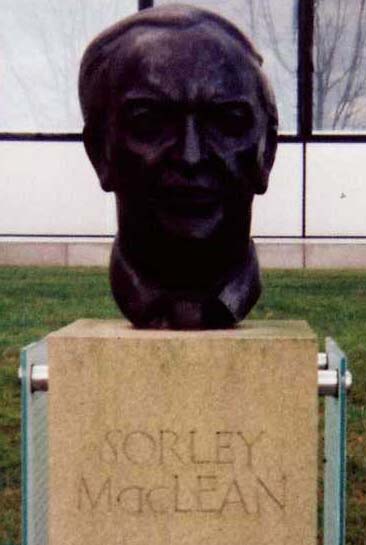
Sorley MacLean: The Gaelic Voice of Raasay
Sorley MacLean was born on Raasay on 26 October 1911, into a world rich in Gaelic song and music. From that small island he developed a poetic voice that would travel far beyond the Hebrides, placing Gaelic experience inside the great political, artistic and moral arguments of twentieth-century Europe.
Raasay, language and memory
Known in Gaelic as Somhairle MacGill-Eain, he grew up in a family where oral culture was living knowledge. His father, Malcolm, was a tailor, while both sides of the family were recognised for their songs and music. Raasay and neighbouring Skye gave MacLean a landscape, language and historical memory that remained central to his work.
That inheritance included the memory of clearance and displacement. On Raasay, abandoned townships were not abstract symbols; they were part of the visible landscape and the stories carried by Gaelic speakers. MacLean’s later treatment of place could therefore hold the living and the lost together, making an island path or ruined settlement part of a wider argument about history.
Bringing Gaelic into the modern world
He went to the University of Edinburgh to study English and graduated in 1933 before training as a teacher. His reading widened, but Gaelic was not left behind. Instead, he brought its inherited forms and music into contact with poets, thinkers and political movements from elsewhere in Europe.
That combination could be startling. When Dàin do Eimhir agus Dàin Eile appeared in 1943, some readers questioned whether poetry so modern in subject and outlook could still be truly Gaelic. The collection explored love, political commitment and the crisis of a continent marked by fascism and war. Today it is regarded as a landmark in modern Gaelic literature.
Poetry shaped by war and politics
MacLean’s life had already been shaped by the conflict he wrote about. Conscripted into the Royal Corps of Signals in 1940, he served in North Africa and was seriously wounded at the Battle of El Alamein in 1942. He was discharged the following year. The experience of war sharpened, rather than simplified, his awareness of courage, suffering and political responsibility.
Another major work, An Cuilithionn, used the Cuillin mountains of Skye as the setting for a long meditation on politics and human struggle. MacLean’s poetry repeatedly joined things that might seem far apart: island history and European revolution, traditional Gaelic song and modernist experiment, intimate love and public duty.
A life in teaching and poetry
He was not a full-time literary figure removed from everyday life. MacLean returned to teaching, later becoming headmaster at Plockton. He and his wife raised three daughters. After retiring to Skye in 1972, he served as Creative Writer in Residence at the University of Edinburgh and as Filidh, or poet, at the developing Gaelic college Sabhal Mòr Ostaig.
Translation helped his reputation spread among readers who could not read the Gaelic originals. Yet translation also raises an important point: MacLean’s sound, rhythm and verbal precision belong first to Gaelic. An English version can open a door, but it cannot carry every meaning or musical effect across the threshold.
This is especially important when discussing him for a general audience. The aim is not to place Gaelic behind a pane of glass as something ancient and remote. MacLean used it as a language of modern thought, capable of handling desire, ideology, violence and doubt. His work asks readers to see linguistic survival as creative power, not merely preservation.
A legacy beyond the islands
His 1989 collected poems, From Wood to Ridge, brought major recognition, including Scottish Book of the Year honours and the Queen’s Gold Medal for Poetry. By the time of his death in 1996, MacLean was widely regarded as the outstanding Gaelic poet of his century and one of modern Scotland’s most important writers.
His achievement was not simply to preserve a threatened literary tradition. He proved that Gaelic could speak urgently about the modern world. Rooted in Raasay, his poetry crossed borders of language and nation without losing the island ground beneath it. That is why Sorley MacLean remains both a Gaelic voice and a European one.