
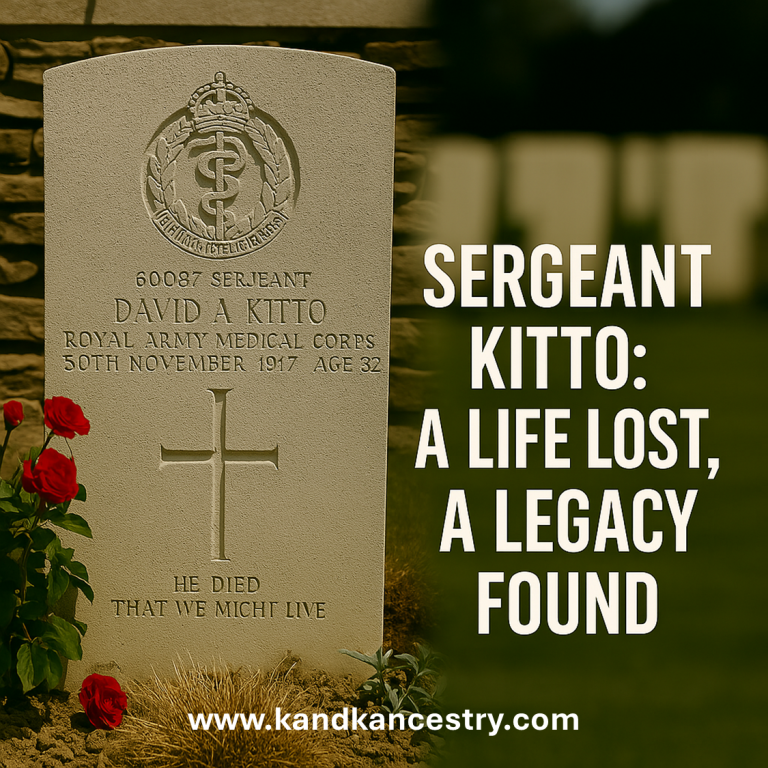
Sergeant David Alexander Kitto: The Soldier Found 73 Years After Cambrai
Originally published 9 July 2025
This week I am bringing you a story of a family reconnecting with a long-lost close relative that is described in a book I acquired recently from Lanarkshire Family History Society, called ‘Harthill – The Village That Went to War’. The village of Harthill in North Lanarkshire is where I live and was brought up.
The book remembers those who served during World War I who had some connection to the village of Harthill. There are so many great tributes in this book but one in particular has stood out to me. Every so often you read or hear something that just seems to resonate with you. In this line of work this happens regularly. I always find myself compelled to carry out some further research in these cases and here is the summary of what I personally collected and what I read in the book.
I hope you find the story of Sgt David Alexander Kitto as interesting as I did.
He was born on 26 September 1885 at Braefoot, Carnoustie, the son of Thomas Kitto and Margaret Shands. He was the second oldest of a family of six. Although he started out his working life as an apprentice plumber, according to the 1901 census, he went on to gain a BSc in Chemistry from St Andrews University and found his way to Harthill, Lanarkshire, where he became a teacher of science at Harthill Public School. In June 1915 he joined the Royal Army Medical Corps.
He met Isabella MacLure at teacher training college, and he took a short period of leave to marry her on 28 October 1915 in Dundee. Isabella was also a teacher at Harthill but returned to Arbroath and became a well-known teacher at Arbroath Primary School. She never remarried and died on 25 August 1979 at the age of 88 years.
David was promoted to Sergeant and in May 1916 he was sent to France. In November 1917 he was serving with the 37th Field Ambulance and was part of the British offensive known as the Battle of Cambrai, which began on 20 November. Cambrai was a British attempt to take advantage of a perceived weakness in the German Hindenburg Line. It was the first time tanks were used to spearhead the attack rather than the traditional artillery.
The British attacked on a six-mile front to the west of the town, achieving initial success. However, they were unable to dislodge German artillery and infantry from the hills dominating the advance and enemy reinforcements, which were rushed to the area, mounted a counterattack on 30 November. During the first day of the counterattack David was killed by a shell at Bourlon Wood. He was 32 years old. His body was not recovered, and his family were left unaware of his whereabouts.
In the end the battle resulted in 80,000 German and 42,000 British casualties. David’s name was listed among the missing on the memorial at Cambrai.
In early 1990 the remains of RAMC shoulder flashes, a razor, a watch and a penknife were ploughed up by farmers near the village of Villers-Plouich, near Cambrai. The farmers contacted the authorities, and permission was granted for further excavation. Human remains were discovered and following extensive research, the remains were found to be David’s. Although his wife was deceased, his brother-in-law, Adam MacLure, aged 90 years, was located and his family helped with the arrangements for the funeral.
The funeral took place on Friday 11 June 1993 at Terlinethun British Cemetery, near Wimille in the Pas-de-Calais region. The funeral was held according to the rites of the Church of Scotland and Sergeant Kitto’s regiment provided the bearer and saluting party, all the men coming from the 2nd Armoured Field Ambulance, RAMC, based in Osnabrück, Germany. Civil representatives of the British and French governments were present as he was buried with full military honours.
David’s nephew, Neil MacLure, said:
“David Kitto was thought of often in our home. We were very much aware of the fact that he had died in the First World War at a place unknown and that no trace of him had ever been found. As children, we came with our father often to France and we visited many war cemeteries looking for a trace of him. Today is very much the closing chapter.”