
Scottish Coal Mining: The Industry That Shaped Communities
Originally published 17 July 2025
If you had ancestors who lived in the central belt of Scotland, there is a good chance you will have ancestors who were employed in the coal mining industry. The history of Scottish coal mining spans over 800 years and significantly contributed to Scotland’s economic, industrial, and social development. The earliest records date back to the 12th century when monks at abbeys, such as Dunfermline Abbey, used coal from surface outcrops for heating.
From the early 1600s until the Coal Mines Act of 1799–1800 abolished it, miners and their families were legally bound to their masters' collieries for life, a system known as bondage. Working conditions were extremely dangerous without proper support, lighting, or ventilation. Workers often used their bare hands and spent long hours crouched or crawling.
In the late 18th to 19th centuries, coal became essential for the iron and steel industries, railways, and steamships. Deep mining expanded rapidly in Lanarkshire, Fife, Ayrshire, and the Lothians. Towns such as Airdrie, Coatbridge, and Motherwell developed around mining and heavy industry. Miners worked 10 to 12 hours a day, six days a week. Mechanisation began slowly, and there were frequent mining disasters. Black lung disease (pneumoconiosis) was widespread.
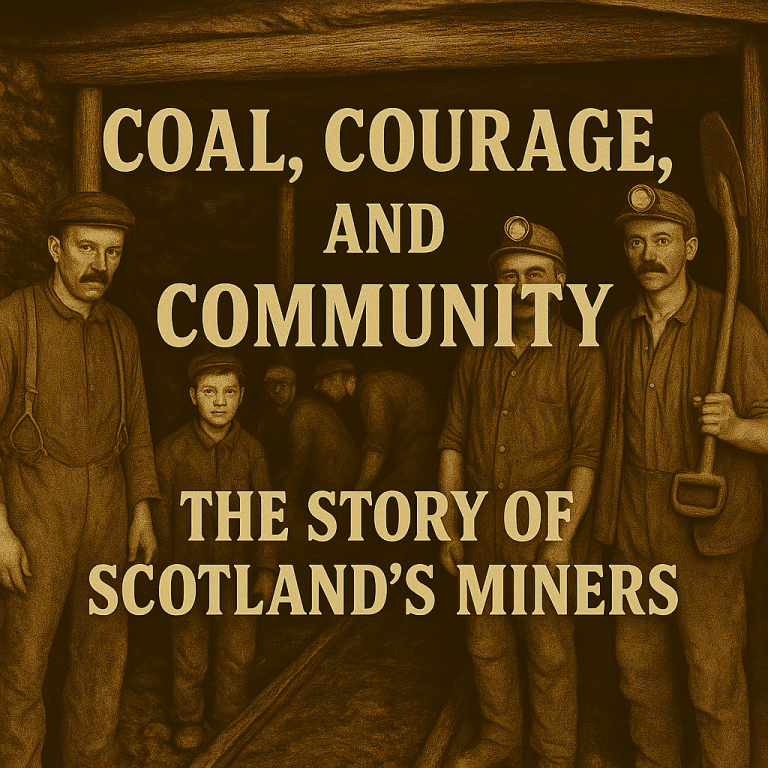
Prior to the Mines and Collieries Act 1842, the typical starting age for miners was between five and seven years old. Women and young girls were also found working in the pits. The 1842 Act raised the minimum age for boys to work underground to ten years old and prohibited women and girls of any age from working underground. In the early 20th century, the typical minimum age was 14-16 years old.
Coal mining accidents were tragically common, especially in Scotland’s deep pits during the 19th and early 20th centuries. The major contributors to these disasters were explosive gases, poor ventilation and flooding. Poorly supported mine roofs all too often caved in, crushing workers beneath tons of rock.
By far the worst coal mining disaster in Scotland’s history occurred on 22nd October 1877 in Pits No. 2 and No. 3 of William Dixon's Blantyre Colliery in Blantyre. An explosion killed in the region of 207 miners, with the youngest being a boy of 11. It is believed the accident left 92 widows and 250 fatherless children.
Despite the harsh working conditions and obvious dangers coal mining was pivotal to the development of Scottish industry and thereby the livelihoods of a large part of the population. It was not just the significant number of our workforce who were employed directly in the mines. Coal powered the other heavy industries that were developing at the time – iron and steel, shipbuilding, railways and steam shipping.
It was also important in the social development of the population. Mining communities developed strong local identities, traditions, and a shared sense of resilience. Institutions like miners’ welfare halls, brass bands, and football clubs (e.g. Motherwell F.C.) emerged from these social roots.
By 1913, Scotland had over 140,000 coal miners producing 43 million tons of coal annually. Conditions had improved with better lighting and ventilation, but the mines remained wet, cramped, dark, and noisy. Trade unions began advocating for better wages and conditions. As a result, mechanised cutters and conveyors became more common in larger pits, while surface levels improved significantly.
In 1947, the UK government nationalised the coal industry, creating the National Coal Board. Mechanisation and new technologies were introduced, improving output but reducing jobs. The legal minimum age was raised to 16 years old. Under the National Coal Board, safety training became compulsory. Medical care and welfare improved with more pithead baths and medical checks. However, miners still faced long hours, noise, physical strain, and occupational diseases.
Demand for coal declined due to oil, gas, and nuclear power. Many pits became uneconomical, especially smaller or deeper ones, leading to major pit closures throughout the 1960s to 1980s. Scotland's last deep coal mine, Longannet in Fife, closed in 2002.