Scotland: The Home of Golf
Originally published 12 October 2025
Golf is more than a game. It’s a centuries-old conversation between land and player, shaped by wind, tradition, and quiet determination. Its story begins not with scorecards or sponsorships, but with pebbles struck across coastal dunes — a pastime born of curiosity and connection.
While stick-and-ball games existed across medieval Europe — the Dutch played kolf, the French had jeu de mail, and the Chinese practiced chuiwan — it was Scotland that gave golf its enduring form. By the 15th century, locals along the East Lothian coast were striking stones with curved sticks, navigating natural hazards like rabbit holes and sand dunes. These early games bore the spirit of modern golf: improvisational, landscape-driven, and quietly competitive.
In 1457, King James II banned golf, fearing it distracted young men from archery practice — a military necessity. The ban was repeated in 1471 and 1491 but largely ignored. By 1502, golf had earned royal favour when King James IV purchased clubs from a bowmaker in Perth, becoming the first recorded golfing monarch.
Golf’s prestige grew through royal hands. Mary Queen of Scots, educated in France, is said to have introduced the game to the French court. Her military aides — cadets — lent their name to the modern “caddie”. King Charles I played at Leith Links, and in 1682, the first international golf match was held there between Scotland and England (Scotland won!).
In 1744, the Honourable Company of Edinburgh Golfers drafted the first official rules for the game, establishing a framework that still echoes today.
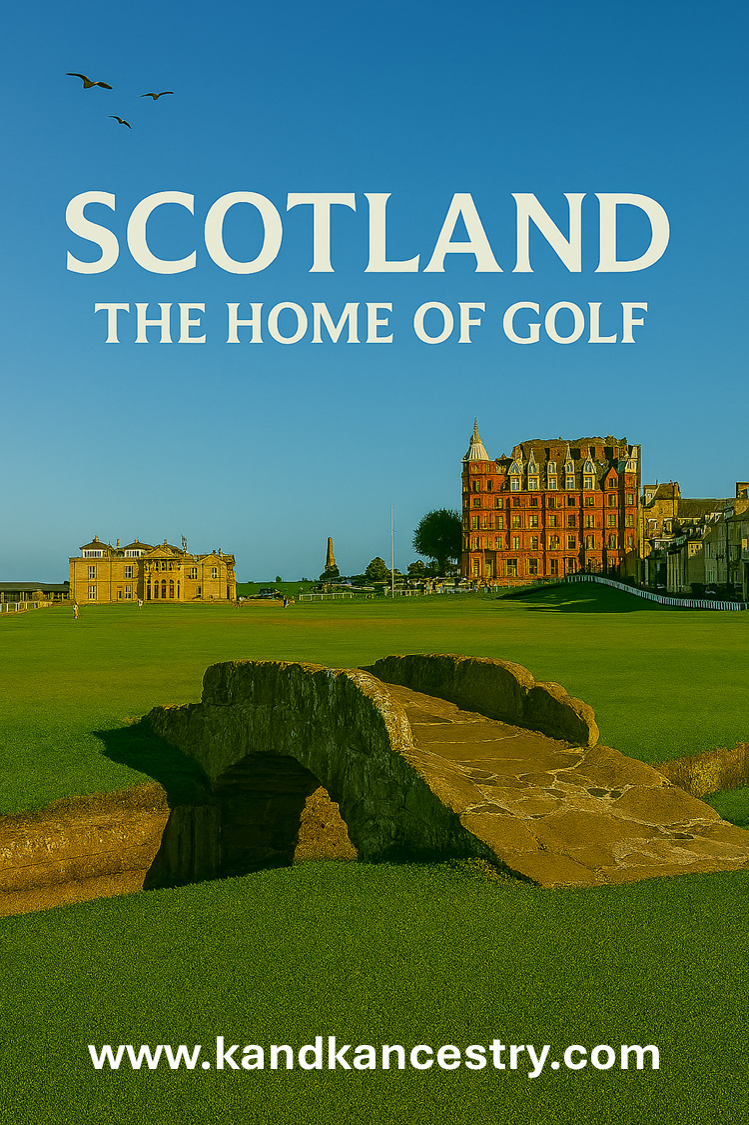
St Andrews, now revered as the “Home of Golf,” began hosting play in the 16th century. Originally featuring 22 holes, the course was reduced to 18 in 1764 — a decision that became the global standard. The Royal and Ancient Golf Club of St Andrews, founded in 1754, would later become one of the sport’s governing bodies, shaping rules and etiquette worldwide.
As the British Empire expanded, so too did golf. The first golf club outside Britain was established in India in 1829. By the late 19th century, clubs had appeared in Australia, South Africa, and North America. The United States saw its first 18-hole course in 1893 at Chicago Golf Club, and the USGA was founded shortly after in 1894.
The Open Championship, first held in 1860 at Prestwick Golf Club, became the oldest of golf’s four major tournaments. Its early winners were Scottish professionals — clubmakers and greenkeepers who honed their craft on rugged links.
The 20th century brought technological advances: rubber-core balls, steel shafts, and televised tournaments. Icons like Bobby Jones, Arnold Palmer, and Tiger Woods transformed golf into a global spectacle. Yet the soul of the game — its quiet rhythm, its respect for land and lineage — remains rooted in its Scottish beginnings.
Scotland has produced some of golf’s most iconic figures — from pioneering legends to modern champions — each leaving a distinct mark on the sport’s history.
Old Tom Morris (1821–1908), born in St Andrews, is widely regarded as the first professional golfer. He won four Open Championships and revolutionized course design and greenkeeping. His influence shaped not only how golf was played, but where — with layouts that still host major tournaments today.
Young Tom Morris, his son, was the sport’s first prodigy. He won four consecutive Open Championships from 1868 to 1872, a feat unmatched to this day. His tragic death at age 24 cut short a brilliant career, but his legacy endures in the Claret Jug and the spirit of competitive golf.
Allan Robertson (1815–1859) was undefeated in match play during his lifetime. His death prompted the creation of The Open Championship in 1860 — a tournament that would become golf’s oldest major.
Sandy Lyle brought Scottish golf to the global stage in the 1980s. He won The Open in 1985 and The Masters in 1988, becoming the first British player to wear the Green Jacket. His swing, resilience, and humility earned him a place in the World Golf Hall of Fame.
Colin Montgomerie, though never a major winner, dominated the European Tour in the 1990s, winning eight Order of Merit titles. His leadership in the 2010 Ryder Cup as captain led Europe to a dramatic victory, cementing his legacy as one of Scotland’s greatest ambassadors.
Scotland has produced over 30 major winners and remains a cradle of golfing excellence. From the windswept links of St Andrews to the fairways of Augusta, Scottish golfers have carried the spirit of the game across centuries and continents.
Golf is a walk-through history. Each course tells a story, shaped by terrain and tradition. Its rituals — the swing, the stance, the solitary focus — invite reflection. And while equipment and technique evolve, the heart of golf remains unchanged: a ball, a club, and the challenge of the course.