
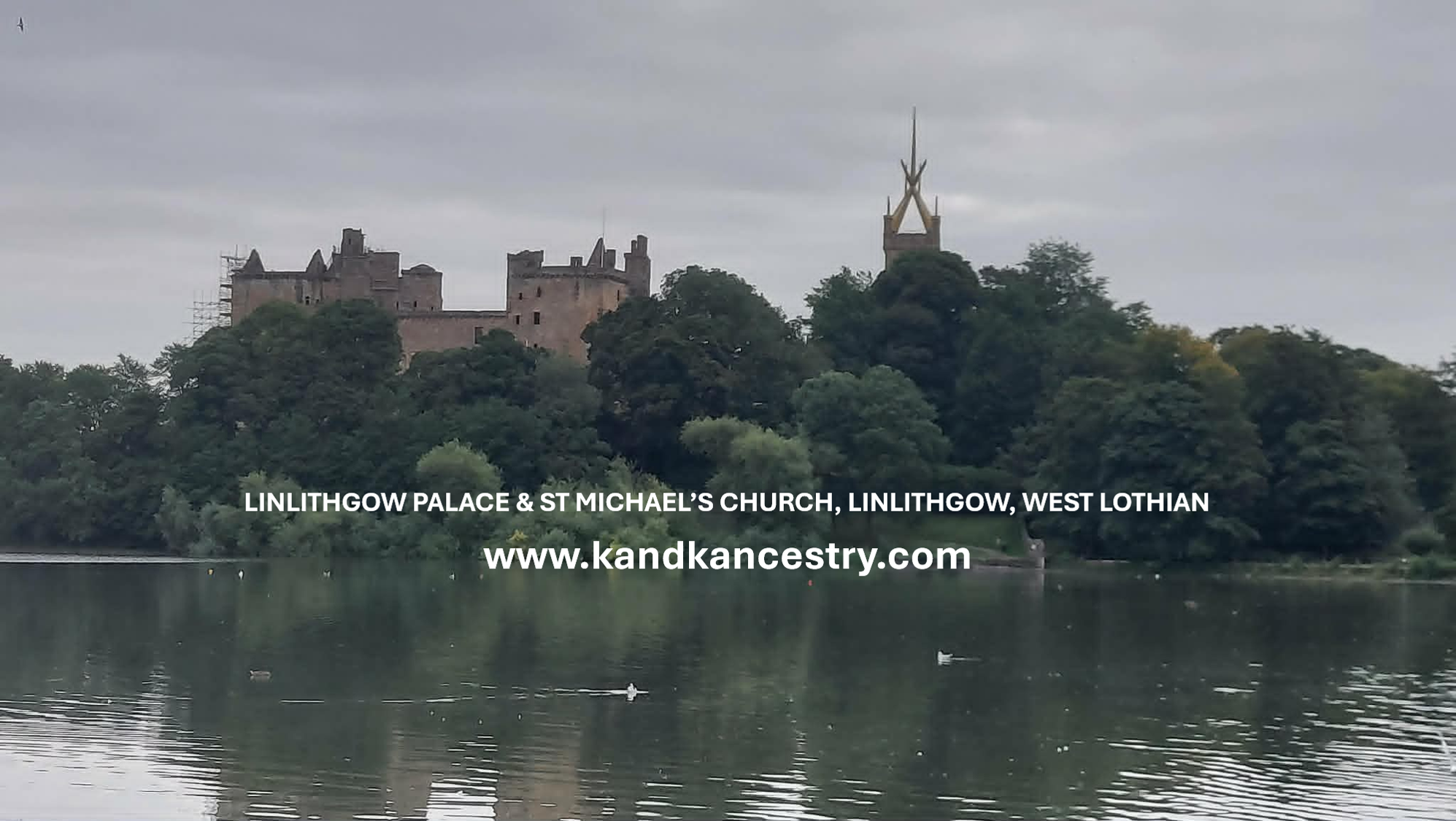
Linlithgow Palace: A Royal Residence at the Heart of Scotland’s Story
Standing above the still waters of Linlithgow Loch, the magnificent ruins of Linlithgow Palace remain one of Scotland’s most impressive links to the Stewart monarchy.
I took this photograph from across the loch in September 2026. Even beneath a typically grey Scottish sky, the palace and the distinctive crown spire of St Michael’s Parish Church create a striking scene. It is easy to imagine how impressive the palace must have appeared when it was filled with courtiers, servants and members of Scotland’s royal household.
From royal manor to magnificent palace
There has been a royal residence at Linlithgow since at least the 12th century. Its location, almost midway between Edinburgh and Stirling, made it a convenient stopping place for Scotland’s kings and queens as they travelled between the country’s two great royal strongholds.
During the Wars of Scottish Independence, the earlier manor was occupied and fortified by the forces of Edward I of England. The site eventually returned to Scottish control, but a devastating fire in 1424 destroyed much of Linlithgow, including the royal residence and the nearby church.
King James I began constructing a new palace on the site. Over the following two centuries, successive Stewart monarchs enlarged and embellished it, transforming Linlithgow into an impressive Renaissance residence built around a central courtyard.
James III, James IV, James V and James VI all left their mark on the building. The result was not simply a defensive stronghold but a comfortable and prestigious royal home intended to display the wealth, authority and growing European ambitions of the Scottish monarchy.
The birthplace of Scottish monarchs
Linlithgow Palace was the birthplace of two of Scotland’s best-known monarchs.
James V was born there in 1512. During his reign, he made substantial improvements to the palace, including the elaborate fountain that still stands in the courtyard. Decorated with royal symbols, mythical creatures and carved figures, it was designed to impress everyone entering the royal residence.
James V’s daughter, Mary, Queen of Scots, was born at Linlithgow Palace on 8 December 1542. Six days later, following the death of her father at Falkland Palace, the infant Mary became Queen of Scotland.
It is one of the extraordinary details of Scottish history: a baby born within the walls of Linlithgow Palace inherited the Scottish crown before she was even a week old.
Mary spent only part of her childhood in Scotland before being sent to France for her safety. Nevertheless, Linlithgow will always be closely associated with the beginning of her remarkable and ultimately tragic story.
A palace filled with life
Today, we see empty rooms, open windows and roofless walls. In its prime, however, Linlithgow Palace would have been alive with activity.
The royal family was surrounded by courtiers, cooks, musicians, guards and servants. Craftsmen maintained and decorated the building, while merchants and local workers supplied food, fuel, cloth and other necessities to the royal household.
The great hall would have hosted feasts and ceremonies. Fires burned in enormous fireplaces, meals were prepared in the palace kitchens and visitors passed through an imposing entrance designed to separate the ordinary world outside from the splendour of the royal court.
The palace was particularly favoured by Scotland’s queens. James IV gave Linlithgow to his wife, Margaret Tudor, following their marriage in 1503. Their marriage connected the royal houses of Scotland and England and would eventually help bring about the Union of the Crowns a century later.
The palace fountain and Bonnie Prince Charlie
One of Linlithgow Palace’s most remarkable surviving features is the ornate fountain within its courtyard.
According to tradition, when Prince Charles Edward Stuart—better known as Bonnie Prince Charlie—visited Linlithgow in September 1745, the fountain was made to flow with wine in his honour.
The prince was travelling towards Edinburgh during the Jacobite Rising of 1745. His visit provided the palace with one final connection to the Stewart dynasty that had created it.
Fire and abandonment
Linlithgow Palace’s importance declined after 1603, when James VI of Scotland inherited the English throne and moved his royal court to London. Although the building continued to be maintained, it was used far less frequently.
Oliver Cromwell’s army occupied the palace during the 1650s. Almost a century later, government troops pursuing the Jacobite army stayed there in January 1746.
After the troops departed, a fire swept through the palace. The building was left roofless and was never restored as a royal residence.
What remains, however, is remarkably complete. Its walls, windows, stairways and grand courtyard allow visitors to appreciate the scale and ambition of the original palace.
Linlithgow and family history
For family historians, places such as Linlithgow Palace are reminders that history was never shaped by monarchs alone.
Behind every royal visit stood countless ordinary people: servants, soldiers, tradespeople, craftsmen, merchants and labourers. The people of Linlithgow supplied the palace, maintained its buildings and witnessed the arrival and departure of Scotland’s royal court.
If your ancestors lived in Linlithgow or the surrounding area, their lives may have been influenced by the palace even if they never appeared in a royal record. Parish registers, burgh records, wills, testaments and kirk session records can help uncover the lives of the wider community that existed around it.
That is one of the pleasures of family history. Famous buildings provide the backdrop, but it is often the stories of the people who lived and worked around them that bring the past fully to life.
Visiting Linlithgow Palace
Linlithgow Palace stands beside St Michael’s Parish Church and overlooks Linlithgow Loch. The surrounding Peel and lochside walk also provide beautiful views of the palace and town.
Visitors can explore much of the palace, climb its winding stairs and look out across the loch from its upper levels. Some areas may occasionally be restricted for conservation work, so it is sensible to check the latest opening and access information before travelling.
The palace is cared for by Historic Environment Scotland. Current visitor information can be found on the official Linlithgow Palace webpage.
More than 280 years after fire left it roofless, Linlithgow Palace continues to dominate the landscape. It remains a place where Scotland’s royal history, the story of Mary, Queen of Scots, and the lives of the wider Linlithgow community all come together.