
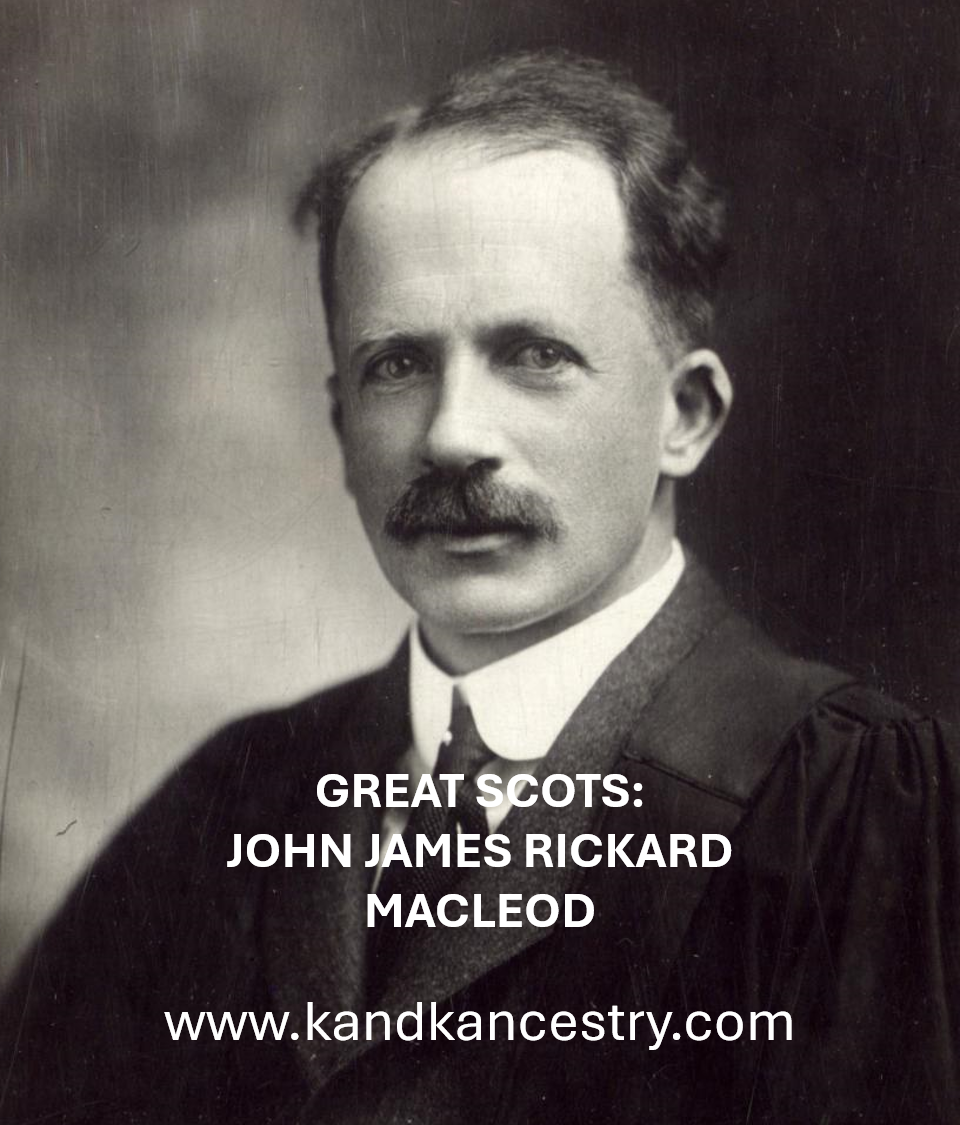
John James Rickard Macleod: The Overlooked Scotsman Behind the Discovery of Insulin
Originally published 6 September 2026.
John James Rickard Macleod was one of Scotland’s most accomplished medical scientists. Yet his contribution to the discovery of insulin was overshadowed for decades by a bitter dispute over who deserved the credit. Today, historians recognise that his knowledge, leadership and scientific judgement were central to a breakthrough that transformed the treatment of diabetes and saved millions of lives.
Early Life and Scientific Career
Macleod was born on 6 September 1876 at Clunie, near Dunkeld in Perthshire. His father, the Reverend Robert Macleod, was a Free Church minister, and the family later moved to Aberdeen. Macleod attended Aberdeen Grammar School and studied medicine at the University of Aberdeen, graduating with honours in 1898. A travelling scholarship then took him to the University of Leipzig.
His time in Germany strengthened his interest in physiology and biochemistry, particularly the way the body uses carbohydrates. After returning to Britain, he worked at the London Hospital Medical School as a demonstrator in physiology and later as a lecturer in biochemistry.
In 1903, Macleod became Professor of Physiology at Western Reserve University in Cleveland, Ohio. Over the following 15 years, he established an international reputation for research into diabetes, metabolism and the pancreas.
The Experiments in Toronto
Following a wartime period as a lecturer at McGill University in Montreal, Macleod joined the University of Toronto in 1918 as Professor of Physiology. By then, he was a recognised authority on carbohydrate metabolism.
In November 1920, the young Canadian surgeon Frederick Banting approached Macleod with an idea for isolating the pancreatic substance that controlled blood sugar. Similar experiments had previously failed, so Macleod was understandably cautious. Nevertheless, he provided laboratory space, equipment, research animals and the assistance of medical student Charles Best.
Banting and Best began their experiments in May 1921. Macleod advised them on their methods and, when the initial findings appeared promising, insisted on further controlled tests. He later expanded the research effort and brought in biochemist James Collip, whose expertise proved essential in purifying the pancreatic extract for clinical use.
A Treatment That Changed Millions of Lives
In January 1922, the purified extract was successfully used to treat Leonard Thompson, a seriously ill teenage boy with Type 1 diabetes. Before insulin, children diagnosed with the condition usually survived only a short time, even when following severe starvation diets.
Insulin transformed a rapidly fatal illness into a condition that could be managed over the long term. It became one of the most important medical breakthroughs of the twentieth century.
The Nobel Prize and a Bitter Dispute
The Nobel Prize in Physiology or Medicine was awarded jointly to Banting and Macleod in 1923. Banting was furious that Best had not been included and shared his prize money with him. Macleod, in turn, shared his half with Collip, acknowledging the importance of the biochemist’s purification work.
The controversy continued for many years. Banting believed Macleod had received too much credit, and his version of events shaped the popular story of insulin’s discovery.
Later examination of laboratory records revealed a more balanced picture. Macleod helped design the research, provided essential facilities and expertise, evaluated the evidence, directed the expanded team and helped move insulin towards becoming a safe clinical treatment.
The researchers also sought to prevent the discovery from being exploited solely for private profit. Banting, Best and Collip assigned their patent rights to the University of Toronto for one Canadian dollar each. The university managed the patents in the public interest and later granted the British rights to the Medical Research Council—an arrangement Macleod helped facilitate.
Return to Scotland
Macleod continued researching insulin and promoted an international standard for measuring its potency. In 1928, he returned to Scotland as Regius Professor of Physiology at the University of Aberdeen.
He continued teaching, writing and researching while also contributing to nutritional science through the Rowett Institute. Macleod died in Aberdeen on 16 March 1935, aged 58.
A Reputation Restored
Macleod did not live to see his reputation restored, but modern scholarship has reclaimed his rightful place in the story. He was not merely a facilitator: he was a scientific leader and co-discoverer whose careful judgement helped turn a promising idea into one of medicine’s greatest achievements.