
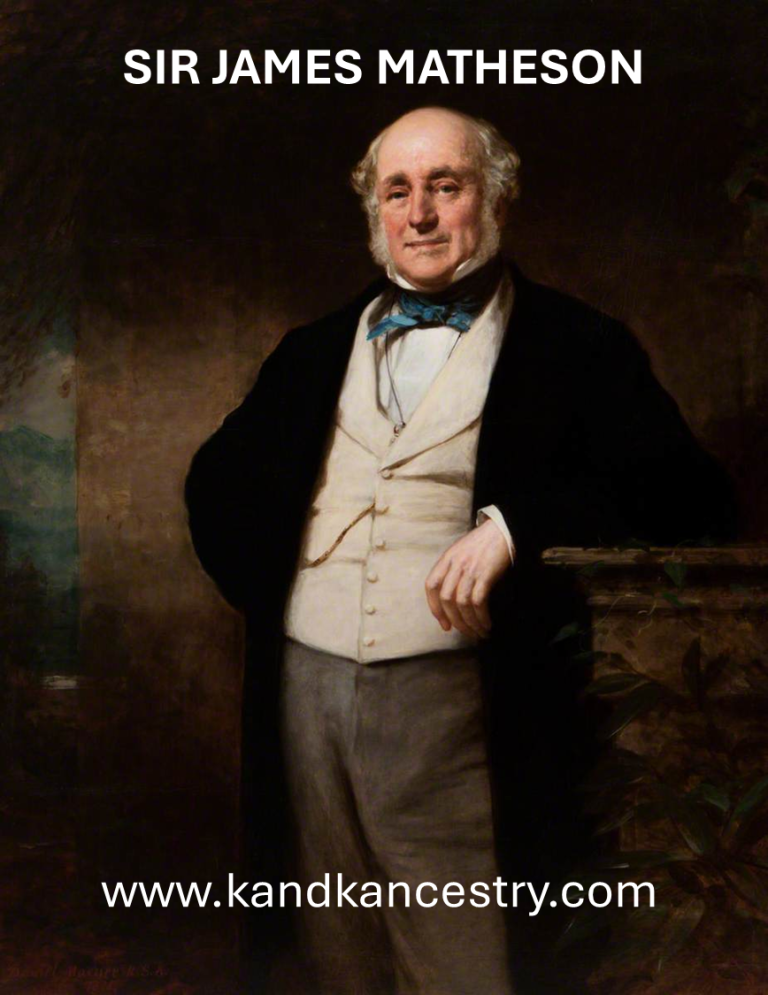
James Matheson: Merchant, Magnate and the Man Who Bought an Island
Originally published 17 November 2025
In the windswept waters off Scotland’s northwest coast lies the Isle of Lewis, a land of ancient stones, Gaelic song, and deep ancestral memory. But in the 19th century, this rugged island became the unlikely possession of one of Scotland’s most enigmatic figures: James Matheson.
Born on this day, November 17, 1796, in Lairg, Sutherland, Matheson was a Highlander by birth but a global entrepreneur by ambition. His journey from the quiet glens of the north to the opium-laden harbours of Canton and the boardrooms of London is a story of empire, enterprise, and enduring legacy.
Matheson’s early years were shaped by the Highland Clearances—a time when many families were displaced from ancestral lands. Perhaps this early exposure to upheaval sharpened his resolve. After studying at Edinburgh and then embarking on a career in trade, he found his fortune in the East.
In 1832, alongside William Jardine, he co-founded Jardine Matheson & Co., a trading house that would become one of the most powerful firms in Asia. Operating out of Canton (now Guangzhou), the company dealt in tea, silk, and—controversially—opium. Their influence was so vast that they played a pivotal role in the events leading to the First Opium War.
Flush with wealth, Matheson returned to Scotland and in 1844 purchased the Isle of Lewis for £190,000. His vision was part philanthropic, part imperial: to modernize the island, improve agriculture, and create employment. He built roads, introduced new industries, and funded schools and churches.
Yet his legacy on Lewis is complex. While some credit him with bringing infrastructure and opportunity, others note that his tenure coincided with continued emigration and hardship. The tension between benevolence and control—between landlord and laird—echoes the broader contradictions of Victorian empire-building.
Matheson’s influence extended beyond commerce. He served as MP for Ross and Cromarty from 1847 to 1868 and was made a baronet in 1851. In Parliament, he advocated for free trade and infrastructure development, aligning with the liberal economic ideals of the age.
James Matheson died in 1878, leaving behind a legacy that is both celebrated and scrutinized. His name endures in Hong Kong’s business circles and in the annals of Scottish landownership. But perhaps most poignantly, it lingers in the stories of Lewis—where the land he once owned still whispers of crofters, clearances, and change.
As we reflect on figures like Matheson, we are reminded that history is rarely simple. It is layered, lived, and often contested. And in telling these stories—honestly and with care—we honour not just the powerful, but the communities they touched.