
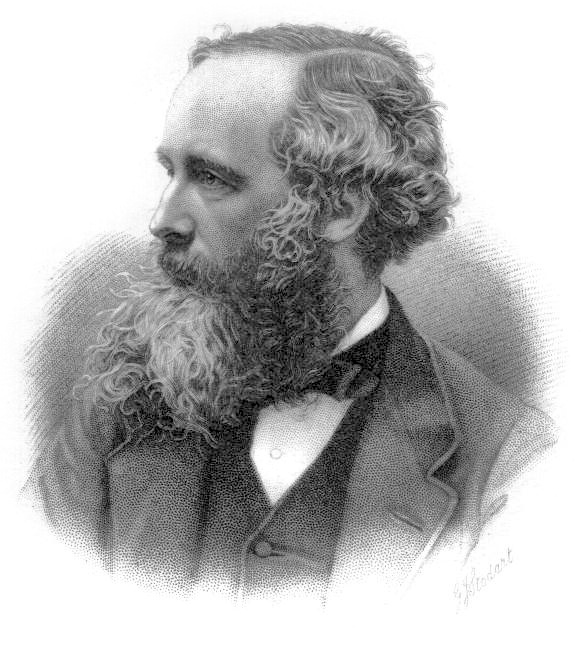
James Clerk Maxwell: The Scot Who United Electricity, Magnetism and Light
A mind that looked for connections
James Clerk Maxwell is less famous than Newton or Einstein, yet much of modern life rests on the world he helped reveal. Radio, television, radar, mobile phones and Wi-Fi all depend on electromagnetic waves. Maxwell did not invent those technologies, but his work showed that such waves must exist and that light itself belongs to the same family.
Born in Edinburgh on 13 June 1831, Maxwell spent much of his childhood at Glenlair, his family’s estate in Kirkcudbrightshire. He was curious about shapes, colours and how things worked. That curiosity survived an unhappy start at school and carried him through the Edinburgh Academy, the University of Edinburgh and, eventually, Cambridge.
At Cambridge, Maxwell became a fellow of Trinity College, but Scotland soon drew him back. In 1856, aged 25, he was appointed professor of natural philosophy at Marischal College in Aberdeen. He married Katherine Dewar there, and their partnership included experiments on colour vision. When Aberdeen’s colleges merged and his post disappeared, he moved to King’s College London. That unsettled path placed him in several of Britain’s liveliest scientific communities.
From Saturn’s rings to colour
Maxwell’s range was remarkable. While still a young man, he investigated the stability of Saturn’s rings. His prize-winning analysis argued that the rings could not be solid or fluid sheets: they had to be made from many separate particles. Spacecraft observations more than a century later confirmed the broad picture.
He also studied how human vision combines colour. In 1861, photographer Thomas Sutton projected three black-and-white photographs of a tartan ribbon through red, green and blue filters during a lecture by Maxwell. The result is often described as the first demonstration of a colour photograph. It was not modern colour film, but it proved that colours could be recreated by combining three primary light signals.
His investigations also reached into heat and gases. The Maxwell distribution helped describe how molecules in a gas move at different speeds, opening another route from visible everyday effects to an invisible mathematical world.
One theory for electricity, magnetism and light
Maxwell’s greatest achievement grew from the experiments of earlier scientists, especially Michael Faraday. Faraday had shown that electricity and magnetism were connected. Maxwell translated experimental insights into a mathematical theory of fields: regions of space in which electrical and magnetic effects could act.
In the 1860s, while professor at King’s College London, Maxwell realised that his equations predicted waves travelling through space at a speed very close to the measured speed of light. The conclusion was extraordinary: light was an electromagnetic wave. Electricity, magnetism and optics were not separate subjects after all.
The four compact equations now taught under Maxwell’s name are later reformulations of his much longer original theory. They describe how electric charges and currents produce fields, and how changing electric and magnetic fields generate one another. Later experimenters, including Heinrich Hertz, detected the waves that Maxwell’s theory predicted. Radio pioneers then found ways to use them.
Building a home for experimental physics
In 1871 Maxwell became the first Cavendish Professor of Experimental Physics at Cambridge. He helped plan and equip the new Cavendish Laboratory, bringing measurement and experiment into a university culture still strongly shaped by mathematics. He also edited and published the electrical researches of Henry Cavendish, rescuing important eighteenth-century work from obscurity.
Maxwell died in Cambridge on 5 November 1879, aged only 48. His life was short, but his ideas travelled far. Einstein later built on the picture of light and fields that Maxwell had helped establish. Today, every wireless signal is a quiet reminder of an Edinburgh-born Scot who discovered that apparently different forces were expressions of one connected world.