
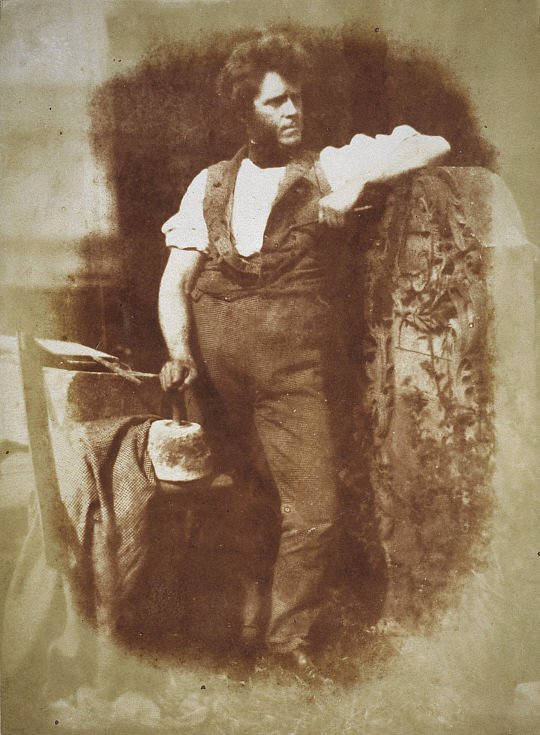
Hugh Miller: The Stonemason Who Read Scotland's Rocks
Long before geology became a familiar school subject, Hugh Miller learned to read the ground beneath his feet. Born in Cromarty on 10 October 1802, he grew from an ordinary Highland childhood into one of Victorian Scotland’s best-known writers on rocks, fossils, faith and society.
A quarry for a classroom
Miller’s route into science did not begin in a university lecture room. As a young man he trained as a stonemason, working with the stone itself and seeing freshly cut rock faces at close quarters. Quarries became his classrooms. The patterns and fossils inside the stone were not curiosities to him; they were evidence of worlds far older than recorded human history.
The work was hard on his body, but it also gave him an eye for layers, textures and breaks in the rock. Moving between building sites exposed him to different formations and encouraged the habit that defined his later writing: look closely first, then connect the detail to a much larger story.
That practical beginning mattered. Miller understood the knowledge held by working people, and he wrote for readers who might never join a learned society. He collected fossil fish from the Old Red Sandstone around Cromarty and elsewhere in northern Scotland, observing their structures carefully and turning difficult geological ideas into memorable stories.
Bringing ancient Scotland to life
His 1841 book The Old Red Sandstone brought him a wide audience. It combined close observation, lively description and the landscape of the Highlands. At a time when geology was transforming ideas about the age and history of the Earth, Miller helped readers picture vanished lakes and armoured fish where they now saw cliffs, fields and paving stone.
Writer, editor and public voice
But geology was only one part of his life. Miller was also a folklorist, author, newspaper editor and campaigner. The National Trust for Scotland describes him as a man of faith and a social justice campaigner as well as a fossil hunter and geologist. As editor of The Witness in Edinburgh, he became an influential public voice during a period of intense religious and political argument.
His writing crossed boundaries that now seem firmly separated. A discussion of fossil fish might sit beside local legend, autobiography or an argument about education and working life. That breadth helped him reach people who did not think of themselves as scientists. It also makes him valuable to family historians: his books preserve the language, labour and beliefs of nineteenth-century Scotland as well as its geology.
Evidence, faith and personal struggle
Miller’s achievements are sometimes summed up by calling him ‘self-taught’. That is true in the sense that he had no formal geological degree, but it can hide the discipline behind his work. He read widely, corresponded with specialists, gathered specimens and tested ideas against physical evidence. His skill lay not only in discovery but in communication: he made deep time feel immediate.
There were tensions in his thinking. Miller tried to reconcile geological evidence with his Christian beliefs, and some of his interpretations belong firmly to the debates of his own century. He died in 1856, three years before Charles Darwin published On the Origin of Species, so it would be misleading to present him simply as an opponent of Darwin’s later book.
His final years also included severe mental distress, and accounts of his death should be handled with care rather than used for drama. A life of remarkable public achievement can still contain pain that was poorly understood and treated at the time.
A legacy rooted in Cromarty
In Cromarty, the thatched cottage where Miller was born stands beside a museum holding fossils, tools and manuscripts. The beach and rocks that formed his first field laboratory remain close by. That setting explains much of his appeal: Miller’s science began with attention to a particular place.
His legacy is larger than a collection of fossil fish. Hugh Miller showed that knowledge did not belong only to universities or wealthy gentlemen. A stonemason with patience, curiosity and a gift for words could make Scotland’s rocks speak to the world.