Hogmanay Through the Ages: Scotland’s New Year Traditions Across the Centuries
Originally published 29 December 2025
New Year in Scotland has never been just a date on the calendar — it’s a season, a feeling, and for many, the most important celebration of the year. Long before fireworks lit the skies above Edinburgh, Scots were marking the turning of the year with fire, feasting, and rituals rooted in ancient belief. Today, Hogmanay remains one of Scotland’s most distinctive cultural touchstones, blending centuries-old customs with modern spectacle.
Ancient Beginnings: Fire, Folklore, and the Winter Solstice
Long before the word Hogmanay appeared in the records in 1604, Scotland’s midwinter traditions were shaped by Norse and Celtic celebrations of the winter solstice. Fire was central — a symbol of protection, purification, and the return of the sun. These early rituals aimed to drive away evil spirits and welcome brighter days ahead.
Echoes of these ancient customs survive today in Scotland’s fire festivals, from the blazing torches of the Comrie Flambeaux to the famous Stonehaven Fireballs Ceremony, where locals swing flaming spheres through the streets to “burn off” the old year.
The Rise of Hogmanay
The term Hogmanay has mysterious origins — possibly French, Norse, or Gaelic — but by the early 17th century it was firmly part of Scottish life. After the Reformation, Christmas celebrations were discouraged in Scotland, so the feasting, gift‑giving, and merrymaking that happened elsewhere on Christmas shifted to New Year instead. This helped cement Hogmanay as Scotland’s biggest winter celebration.
First-Footing: Welcoming Luck at the Door
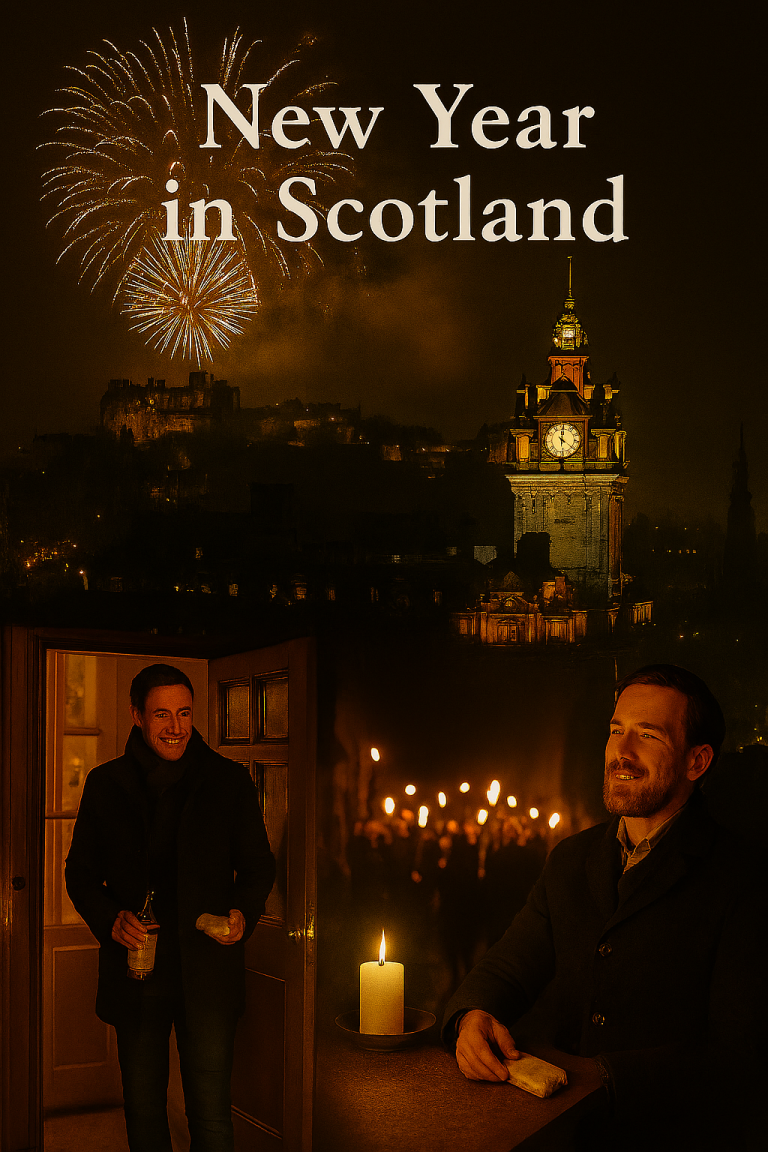
Perhaps the most iconic Hogmanay tradition is first-footing. Just after midnight, the first person to cross a household’s threshold sets the tone for the year ahead. Traditionally, the luckiest first-footer is a tall, dark-haired man — a superstition that may date back to Viking times, when a fair-haired stranger at the door was rarely good news.
A proper first-footer brings symbolic gifts:
Coal for warmth
Shortbread for hospitality
Salt for prosperity
Whisky for good cheer
These tokens represent abundance and good fortune for the year to come.
Redding the House: Clearing Out the Old Year
Another long-standing custom is the “redding” — a thorough cleaning of the home before midnight. Traditionally this included clearing out the ashes from the hearth, symbolically removing the remnants of the old year to make space for the new. Even today, many Scots still feel the urge to tidy up before the bells.
Auld Lang Syne: Scotland’s Gift to the World
No New Year celebration is complete without Auld Lang Syne, written by Robert Burns in 1788 and now sung across the globe as the clock strikes midnight. Linking hands in a circle, Scots honour friendship, memory, and the passing of time — a moment of unity that has become one of Scotland’s most enduring cultural exports.
Modern Hogmanay: From Hearthside to Global Stage
While many traditional customs remain, Hogmanay has grown into a world-famous celebration. Edinburgh’s Hogmanay Festival — with its torchlight processions, concerts, and fireworks — draws visitors from around the world and showcases Scotland’s talent for hospitality and spectacle.
Yet at its heart, Hogmanay is still about community: visiting neighbours, sharing food and drink, and marking the turning of the year with warmth and togetherness.
Why Hogmanay Endures
Scotland’s New Year traditions have survived because they speak to something universal: the desire to honour the past, clear the slate, and step into the future with hope. Whether through fire festivals, first-footing, or a simple dram shared with friends, Hogmanay remains a celebration of connection — to our history, our communities, and each other.
Wishing you all a guid New Year
Ian