
HMS Timbertown: The Lewis Sailors Interned in the Netherlands
Originally published 17 August 2025
At the beginning of World War I, Germany invaded neutral Belgium on 4 August 1914, using the country as an entry point to France. The Belgian army, after significant resistance, withdrew to the fortified city of Antwerp, where a large number of Belgian refugees had already taken shelter from the conflict. The Belgian army command considered abandoning Antwerp and moving the army south, contrary to British interests.
Britain was concerned that German control of Belgian and French ports would disrupt connections with France and threaten British supply routes through the Channel.
Winston Churchill, then First Lord of the Admiralty, traveled to Antwerp on 2 October to encourage the Belgians to maintain their defense for as long as possible, providing Britain and France time to establish a defensive line in northern France. However, there were no available British or French troops to directly support the Belgians at that time.
During his journey, Churchill recognized that he could deploy three brigades under his authority, totaling approximately 6,000 men. The 3rd Royal Naval Brigade consisted of professional marines, while the 1st and 2nd Brigades were composed mainly of reservists and volunteers with limited training and equipment. On 4 October 1914, these forces were urgently mobilized to assist at Antwerp.
On 5 October, the 1st and 2nd Brigades arrived in Dunkirk and soon proceeded by train to Antwerp, where they were welcomed by the local population. They advanced to the front lines near the river Nete, where fighting took place on the same day. The engagement resulted in a retreat of both the Belgian and British forces to the outer ring of Antwerp’s forts.
This allowed German heavy siege artillery to be positioned within range; the outdated fortifications were unable to withstand the bombardment, making the fall of Antwerp imminent.
To avoid encirclement, it was decided that the field army and British Brigades would withdraw across the Scheldt on the night of 8 October. The British troops were scheduled to travel by train to Ghent. Due to communication issues, Commodore Wilfred Henderson, commanding the 1st Royal Naval Brigade, did not receive orders to leave immediately. Later, upon learning of the destruction of railway lines and the German advance, Henderson determined that evacuation to Ghent was no longer feasible.
He chose to cross into the Netherlands, resulting in internment according to international law for the remainder of the war.
Upon crossing the Dutch border, the troops were disarmed and informed they would reside in a guarded camp for the war’s duration, in accordance with international law provisions preventing them from rejoining hostilities. More than 30,000 Belgian soldiers also entered the Netherlands and were interned during 1914–1918.
The British spent their first night in the Netherlands outdoors before being transported by train to Terneuzen and then by ship to Vlissingen. A group of about 500 continued to Leeuwarden, while approximately 1,000 were sent to Groningen.
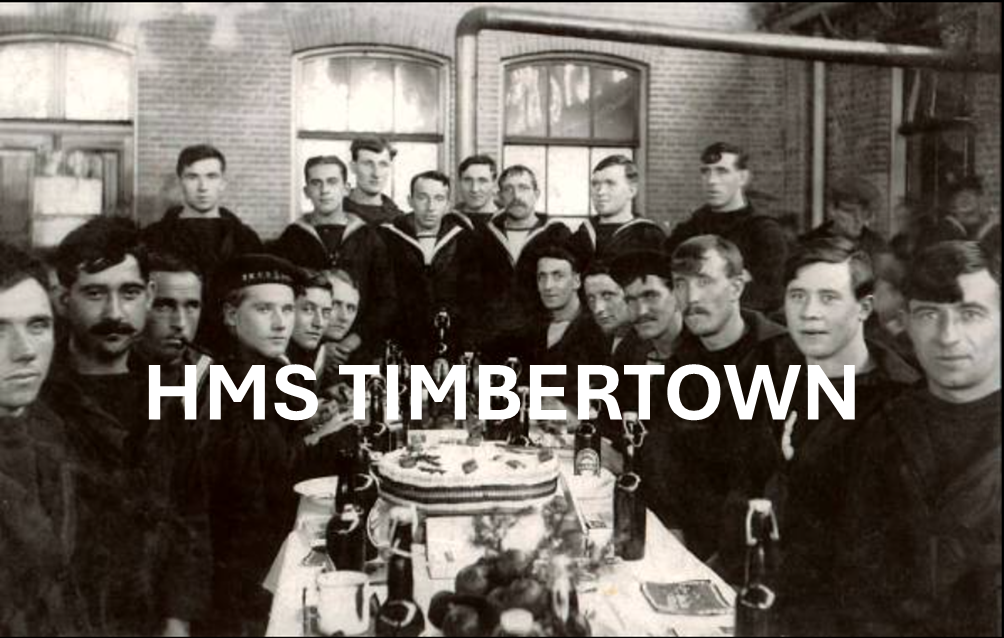
“HMS Timbertown” was the term used by British sailors for the wooden-hut internment camp built near Groningen, in the neutral Netherlands, following the retreat from Antwerp. Around 1,500 members of the 1st Royal Naval Brigade were interned there according to international law. Locals referred to the site as the “English Camp,” while the nickname “Timbertown” referenced its wooden construction.
By early 1915, the camp featured facilities such as a post office/library, sports hall, medical area, recreation room/church, and rations supplemented by parcels and a camp budget. Daily activities included exercise, work or study, and limited evening outings to the city. Sundays were reserved for religious services.
Sports and cultural activities were organized, including football, rugby, athletics, boxing, cricket, and performances by groups like the “Timbertown Follies.” The camp also produced items such as knitted uniforms and woodwork for sale, helping fund additional supplies. Public visits were permitted on some Sundays.
From April 1915, internees were allowed to perform paid, non-military work due to labor shortages in the Netherlands. Early escape attempts occurred, occasionally with local assistance, leading to diplomatic issues. By 1916, the British government began returning escapees to uphold Dutch neutrality. Over time, camp regulations relaxed, permitting compassionate leave and, later, group home leave on trust.
The story has a strong Hebridean thread. Contemporary research tied to the BBC ALBA documentary HMS Timbertown records that about 102 of the 1,500 internees were from the Isle of Lewis—a striking concentration for one island community. The grandfather of one of our followers, Margaret Stewart was one of those from Lewis interned there. Donald Graham, 71 Coll, Isle of Lewis was born on 18th October 1891 and was the son of Alexander Graham and Margaret MacRae.
He enrolled with the Royal Naval Reserve on 28th January 1910, and his war service stretched from 5th August 1914 to 6th March 1919. He continued to serve with the Royal Naval Reserve until 1935.
Donald married Margaret MacLeod of 55 Coll on 26th December 1929. They went on to have two children, Alex Angus and Agnes (Margaret’s mother).
Donald features in both photographs. In the first he is 3rd from the right and in the second he is seated. Both photographs were taken at HMS Timbertown. Thank you to Margaret Stewart for sharing these brilliant photographs.
The BBC Alba Documentary can be viewed below….