
Glasgow’s Trams: The Rise and Fall of a City Institution
First published: 4 September 2025
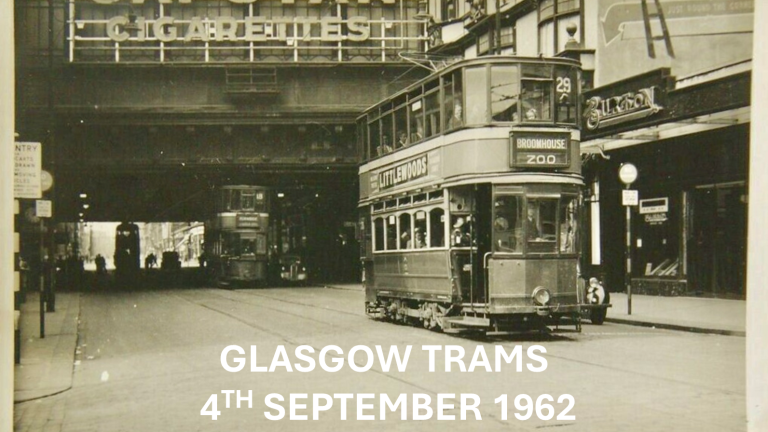
On this day in 1962, Glasgow’s last tram completed its ceremonial journey.
The tramway system in Glasgow played a pivotal role in the city’s transport, infrastructure and urban development for generations. Evolving from horse-drawn carriages to electric vehicles, the trams contributed substantially to Glasgow’s growth and connectivity.
Horse-Drawn Beginnings
- On 19 August 1872, the first horse-drawn tram service commenced, operating between St George’s Cross and Eglinton Toll under the management of the Glasgow Tramway and Omnibus Company. This marked the introduction of public rail transport in Glasgow.
- The establishment of the system was facilitated by the Glasgow Street Tramways Act of 1870, which permitted the Town Council to lay tracks but required private operation for the initial 22 years.
Municipal Takeover
- On 1 July 1894, Glasgow Corporation Tramways assumed control of operations, transitioning the system to municipal oversight. This period was characterised by significant expansion and technological advancement.
Electrification and Expansion
- Around the turn of the 20th century, the tram network underwent electrification, with the inaugural electric route running between Springburn and Mitchell Street.
- By 1922, the network extended over 141 miles of track and operated more than 1,000 trams, positioning it as one of the most extensive urban tram networks in Europe.
Women on the Rails
- During and after the First World War, women were recruited as tram drivers—a notable development in public transport employment at the time. Their involvement persisted until the closure of the system in 1962.
Powering the Network
- Pinkston Power Station, inaugurated in 1901, provided electricity to both the tram system and the Glasgow Subway, remaining operational until the early 1960s.
Decline and Closure
- In 1953, a decision was made not to update the ageing fleet, with diesel and petrol buses considered the future of urban transport. This marked the beginning of the tram network’s phased shutdown.
- By the early 1960s, only the No. 9 route from Dalmuir to Auchenshuggle remained in operation.
The Final Journey
- On 4 September 1962, Glasgow’s last tram completed its ceremonial journey. Large crowds attended to witness the final run of the No. 9 tram from Dalmuir West to Auchenshuggle, signifying the conclusion of the United Kingdom’s last first-generation city tramway.