
Following the Silver Darlings: Scotland’s Herring Girls
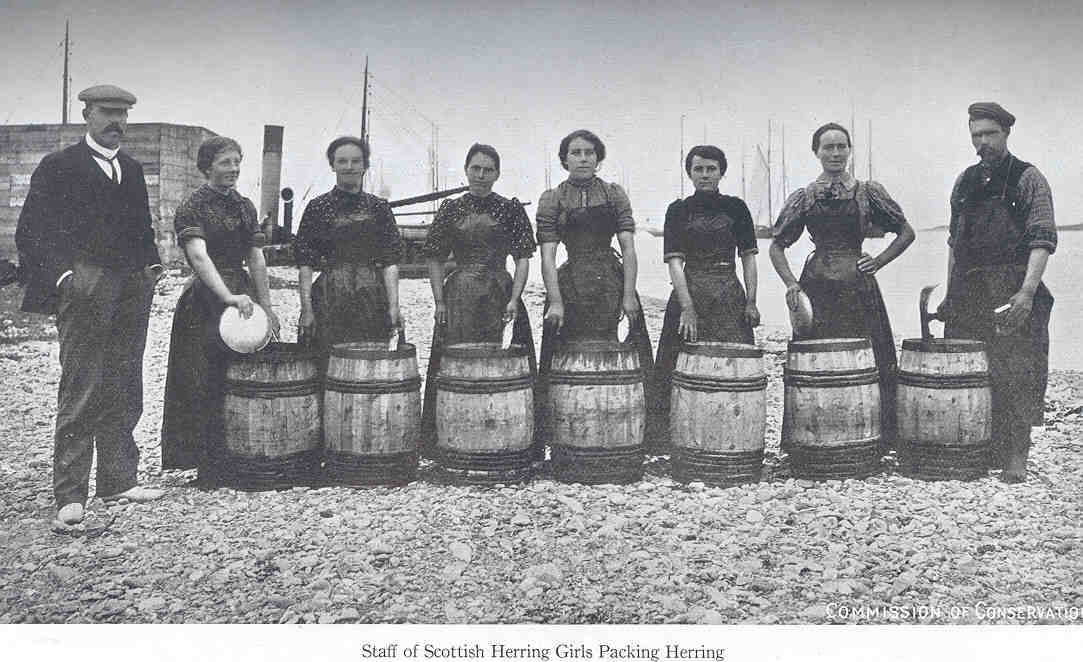
At the height of Scotland’s herring boom, the arrival of the boats was only the beginning. The catch had to be gutted, salted and packed quickly before the oily fish spoiled. Waiting at the quayside were thousands of skilled seasonal workers—the women remembered as the herring girls.
The boom behind the barrels
The trade expanded dramatically during the nineteenth century. Government support, export demand and faster railway links helped Scottish herring reach markets across Europe. The Scottish Fisheries Museum records that, at the boom’s peak in 1907, about 2.5 million barrels were cured and exported. Herring was not simply food; it was the foundation of a vast working world of crews, curers, coopers, merchants and shore labourers.
Women were central to that world. Many came from fishing and crofting communities in the Highlands, the Hebrides, the north-east and the Northern Isles. Some began in their mid-teens. They travelled as the seasonal fishery moved, working at ports including Stornoway, Lerwick, Wick and Peterhead before heading farther south to places such as Great Yarmouth.
Skilled work in punishing conditions
The usual crew contained three women: two gutters and a packer. The gutters used short, sharp knives to clean the fish with a practised movement. The packer arranged the herring carefully in barrels, adding layers of salt so the catch could survive its journey to market. It was skilled, repetitive work performed at speed, often in cold, wet and exposed conditions.
Archive evidence from Wick shows just how demanding a season could be. Herring gutters wrapped strips of cloth around their fingers, but cuts were still common, and salt made them sting. Long hours depended on the boats. Workers might wait without pay when the shoals failed to appear, then labour deep into the day when a heavy catch arrived.
Wages, journeys and independence
Payment was commonly tied to output, so a fast and experienced team could earn more. That income mattered at home. For crofting families, seasonal wages helped support land and households that could not provide enough money on their own. The journeys also gave young women a degree of movement and independence that was unusual in many other kinds of work.
Recruitment and travel were organised in advance. Curers engaged crews for a season, sometimes paying an ‘arles’ or hiring payment, while women carried their belongings in wooden kists. Letters preserved in the Wick archives show workers actively arranging places for themselves and relatives. They were not a faceless labour force: they negotiated, maintained professional reputations and returned to employers over successive seasons.
Hardship, friendship and community
It would be wrong, however, to turn hardship into a simple story of freedom. Accommodation could be basic, employment uncertain and the work physically punishing. Experiences differed between ports, employers and generations. The familiar image of cheerful women singing as they worked captures part of the social life, but not the whole economic reality.
Still, the travelling seasons created strong communities. Women met friends and relatives along the route, carried Gaelic speech and song between ports, knitted while waiting for boats and organised ceilidhs away from home. Family memories of the herring girls often preserve both pride in their skill and the pain of the work.
The end of the great herring seasons
The First World War disrupted fleets and cut off major European markets. The industry recovered unevenly, then faced further shocks from changing markets, mechanisation and another world war. After 1945, Scottish fishing increasingly concentrated on white fish and shellfish, and the great age of the travelling herring crews faded.
Their legacy remains in harbour towns, archives, monuments and family stories. The herring girls followed the ‘silver darlings’ around Britain, but their labour also linked island crofts to an international trade. Every packed barrel carried more than fish: it carried the work of women whose speed, endurance and knowledge helped keep coastal Scotland afloat.