
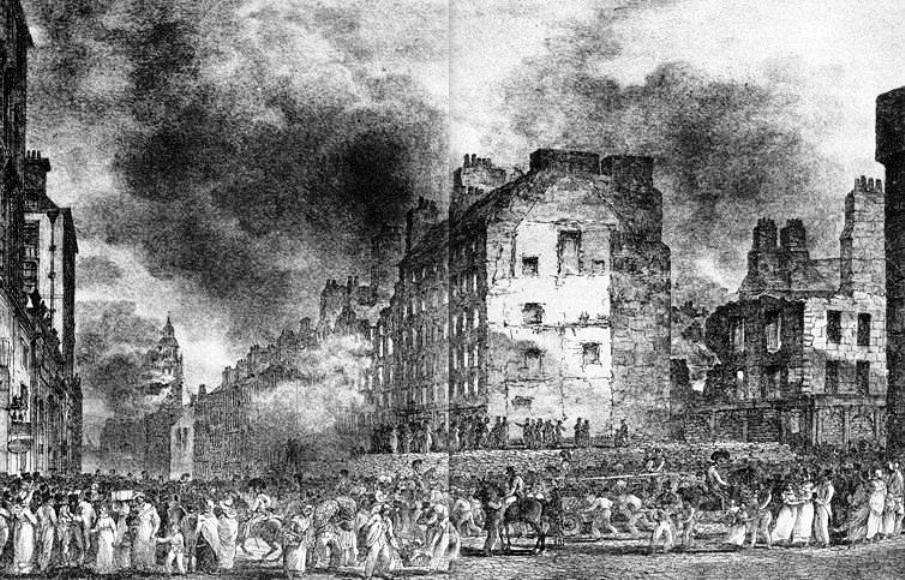
Edinburgh in Flames: The Great Fire of 1824
A glow above the Old Town
At about ten o’clock on the night of 15 November 1824, fire broke out in Edinburgh’s Old Assembly Close, just off the High Street. The precise cause was never established. What followed was easier to explain: tall tenements stood close together, timber ran through their interiors, open fires were part of daily life, and a south-westerly wind carried flames across roofs.
The closes were narrow and crowded. Residents struggled out with whatever belongings they could carry while firefighters tried to move engines, hoses and water through the same confined spaces. Within hours, several tenements had become a single towering blaze, visible from across the city.
This was also a working district. Homes shared the Old Town with printers, engravers, shops and storerooms filled with paper, wood and other fuel. Fire did not simply remove roofs from over people’s heads; it destroyed tools, stock and livelihoods. The disaster spread through a community in which living and working spaces were tightly woven together.
A new brigade faces its first great test
Edinburgh had created its municipal fire service only weeks earlier. Before then, insurance companies maintained separate brigades, chiefly to protect insured property. The new Edinburgh Fire Engine Establishment brought the effort under one command and placed a 24-year-old surveyor, James Braidwood, in charge as Master of Engines.
The organisation was new, its crews were not yet fully trained, and some of the engines supplied to it were worn or inadequate. At the fire, municipal, insurance and older civic crews all appeared, creating uncertainty over command. Water was not effectively applied for roughly an hour, by which time the flames had reached the roofs.
Braidwood nevertheless earned praise for his courage and method. He understood buildings as a surveyor and trained firefighters to reach the source of a fire instead of throwing water blindly at smoke and flame. The Great Fire showed both the promise of organised firefighting and the cost of poor equipment and divided responsibility.
The fire moves towards Parliament Square
The first blaze was not the end. On the evening of 16 November, another outbreak took hold near the High Street and Parliament Close, later rebuilt as Parliament Square. Flames threatened St Giles’ Cathedral and buildings around the law courts. Contemporary accounts describe an immense spectacle, but for people trapped below it was a scene of fear, falling masonry and exhausted rescue work.
Firefighters, soldiers and local people fought through successive outbreaks. Dangerous ruins were brought down to stop them collapsing without warning, and rain eventually helped the crews. The wider disaster continued in stages until 21 November.
Figures vary between accounts, but University of Edinburgh research records around 400 homes destroyed and thirteen deaths. Shops, print workshops and other businesses vanished with them, leaving many people without work as well as shelter. Artists including William Home Lizars recorded the ruined streets and sold engravings to raise money for those made homeless.
What rose from the ruins
The city investigated the response and cleared Braidwood and his young brigade of blame. The lesson was not that an organised service had failed, but that it needed clear authority, sound equipment and disciplined training. Braidwood refined his methods in Edinburgh before becoming the first superintendent of the London Fire Engine Establishment in 1833.
Edinburgh’s Old Town still carries the shape of its long history, but the streets around Parliament Square were altered by rebuilding after the fire. The disaster is therefore more than a dramatic night in the capital’s past. It is also the story of a crowded community, a new public service under pressure, and the beginnings of modern professional firefighting.