
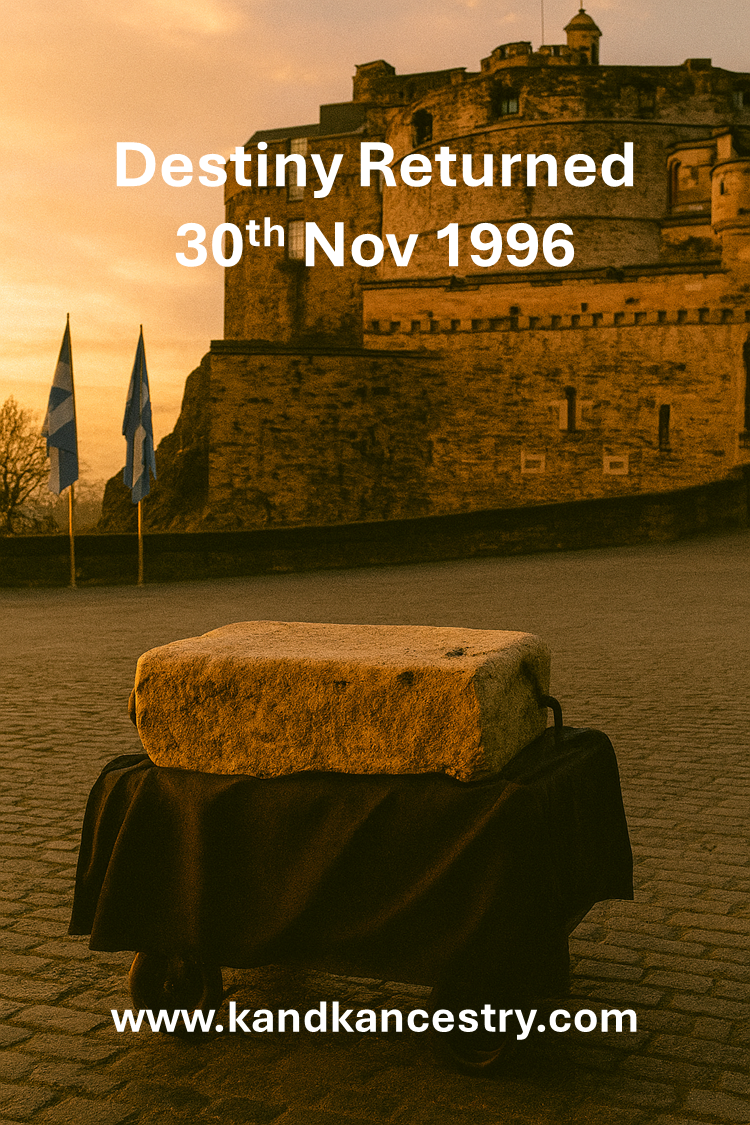
Destiny Returned: The Stone of Destiny Comes Home
Originally published 30 November 2025
As well as being St. Andrew’s Day of course, today marks the anniversary of the Stone of Destiny’s historic return to Scotland in 1996, a moment that remains deeply symbolic of nationhood and cultural pride.
The Stone of Destiny—also known as the Stone of Scone—has shaped Scottish identity for more than a millennium. Traditionally kept at Scone Abbey, it served as the coronation seat for Scottish kings, including Robert the Bruce. Legends surrounding the stone reach even further back, linking it to the biblical Jacob, to ancient Ireland, and to the early kings of Dalriada before it was brought to Scone in the 9th century.
Measuring 66 × 43 × 27 cm and weighing around 152 kg, the oblong red sandstone block became embedded in both myth and monarchy.
Its removal in 1296 by Edward I of England transformed it into an even more potent national symbol. Taken to Westminster Abbey and fitted into the Coronation Chair, it became a physical reminder of Scotland’s loss of sovereignty. For more than 700 years it remained in London, used in the crowning of English and later British monarchs.
This long absence fostered generations of longing and debate, including the famous 1950 Christmas Day raid, when four Scottish students—Ian Hamilton, Kay Matheson, Gavin Vernon, and Alan Stuart—removed the stone from Westminster Abbey. Though it was damaged and later recovered, the act reignited the national conversation around heritage and identity.
The long-awaited homecoming took place on 30 November 1996, St Andrew’s Day, when Prime Minister John Major announced the stone’s return. In a ceremony at Edinburgh Castle, the stone was placed alongside the Honours of Scotland. For many Scots, the return was a powerful cultural and emotional milestone—an act of recognition that transcended questions about the stone’s authenticity, which some historians still debate.
Its presence in Edinburgh Castle restored a sense of continuity with Scotland’s historic monarchy.
Beyond politics, the stone has continued to inspire musicians, poets, and storytellers. Donald McIntyre’s Gaelic poem Òran na Cloiche captured the emotional and cultural weight of the stone’s absence and anticipated return, reflecting its place in the Scottish imagination. The stone also retains its ceremonial role in the United Kingdom, returning to Westminster Abbey for the coronation of King Charles III in 2023 before being transported back to Scotland.
In 2024, the Stone of Destiny moved again—this time to the newly redeveloped Perth Museum, close to its original home at Scone. The relocation has been celebrated as a “homecoming within a homecoming,” reconnecting the stone to the landscape where it first became a symbol of kingship. Despite minor challenges, such as damage to its display case earlier in the year, it remains a centrepiece of Scottish heritage.
Today offers an opportunity to reflect not only on a historic return, but on Scotland’s ongoing narrative of identity, resilience, and cultural expression. The Stone of Destiny continues to stand as a reminder that Scotland’s story is both written in history and literally carved in stone.