
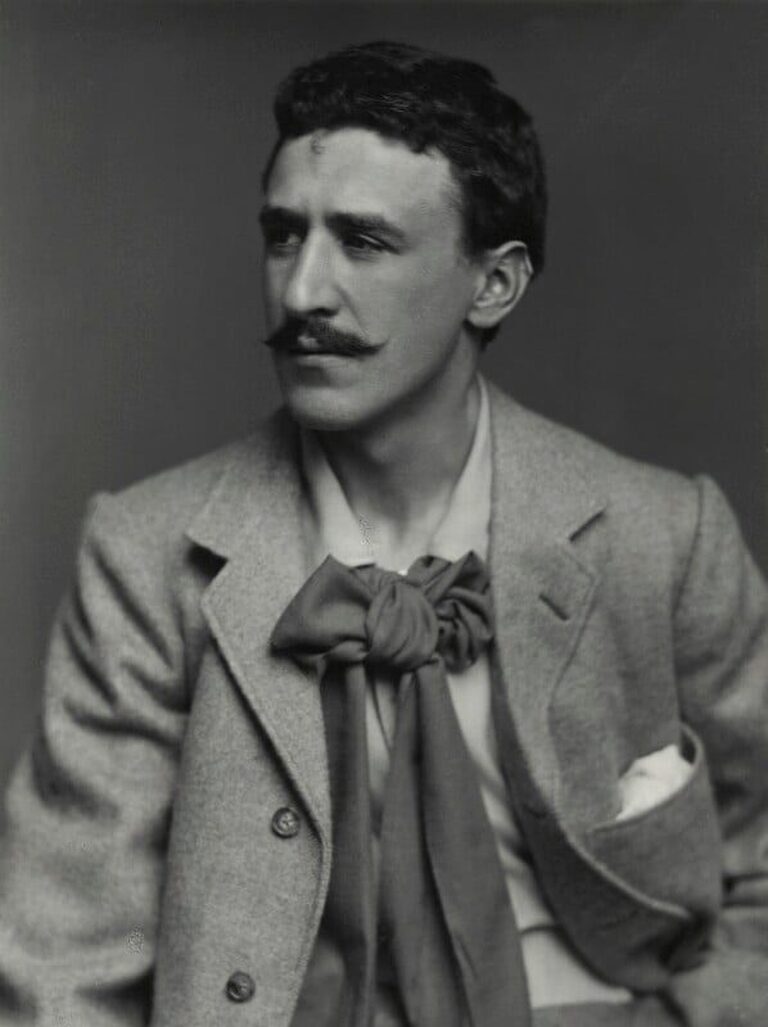
Charles Rennie Mackintosh: A Story of Vision and Belonging
Originally published 10 December 2025
On this day in 1928 Charles Rennie Mackintosh died in London.
When you walk through Glasgow, it’s hard not to feel Charles Rennie Mackintosh’s presence. His buildings don’t just stand; they speak. They whisper of a man who believed that art and life should be inseparable, that every chair, every window, every wall could carry meaning.
Born in Glasgow in 1868, Mackintosh grew up in a city alive with industry. Yet while smoke and steel defined the skyline, he dreamed of light, space, and beauty. As a young apprentice architect, he studied at the Glasgow School of Art in the evenings, sketching ideas that would one day transform the very institution he attended. His talent was undeniable, but it was his imagination—restless, daring, and poetic—that set him apart.
Mackintosh’s story is also one of partnership. In Margaret Macdonald, his wife and collaborator, he found not only love but creative kinship. Together with Margaret’s sister Frances and artist Herbert MacNair, they became known as “The Four.” Their work was radical: elongated figures, symbolic motifs, and designs that seemed to float between tradition and modernity. Margaret’s ethereal panels and Mackintosh’s geometric clarity fused into something entirely new.
It was a marriage of minds as much as hearts.
His masterpiece, the Glasgow School of Art, rose in two phases between 1896 and 1909. To step inside was to enter Mackintosh’s world: soaring windows that poured light into studios, staircases that felt sculptural, and details that balanced utility with poetry. Students didn’t just learn within those walls—they absorbed his philosophy that creativity should be nurtured by the very spaces we inhabit.
Other commissions carried the same spirit. Hill House in Helensburgh, with its blend of Scottish vernacular and modern geometry, feels like a home carved from imagination. The Willow Tearooms, designed for Catherine Cranston, offered Glaswegians a place where every table, light fitting, and stained glass panel was part of a unified vision. Mackintosh believed in “total design”—that architecture, interiors, and furniture should harmonize like instruments in an orchestra.
Yet his journey wasn’t easy. Scotland admired him, but commissions were scarce. Abroad, however, his ideas resonated. In Vienna, artists of the Secession movement hailed him as a kindred spirit. Later, when architectural work dried up, Mackintosh turned to painting. His watercolours of French landscapes reveal a gentler side: quiet villages, sunlit gardens, and a man at peace with nature.
He died in 1928; his reputation muted at the time. But history has a way of circling back. Today, Mackintosh is celebrated as a pioneer who bridged the 19th and 20th centuries, a visionary who showed that design could be both functional and poetic. His legacy endures not only in buildings and furniture but in the idea that art belongs to everyday life.
For those of us who cherish heritage, Mackintosh’s story is more than biography. It’s a reminder that creativity thrives in collaboration, that beauty can rise from industry, and that one person’s vision can shape the identity of a city—and inspire generations far beyond it.