Burke and Hare: Murder, Anatomy and Edinburgh’s Darkest Scandal
Originally published 14 September 2025
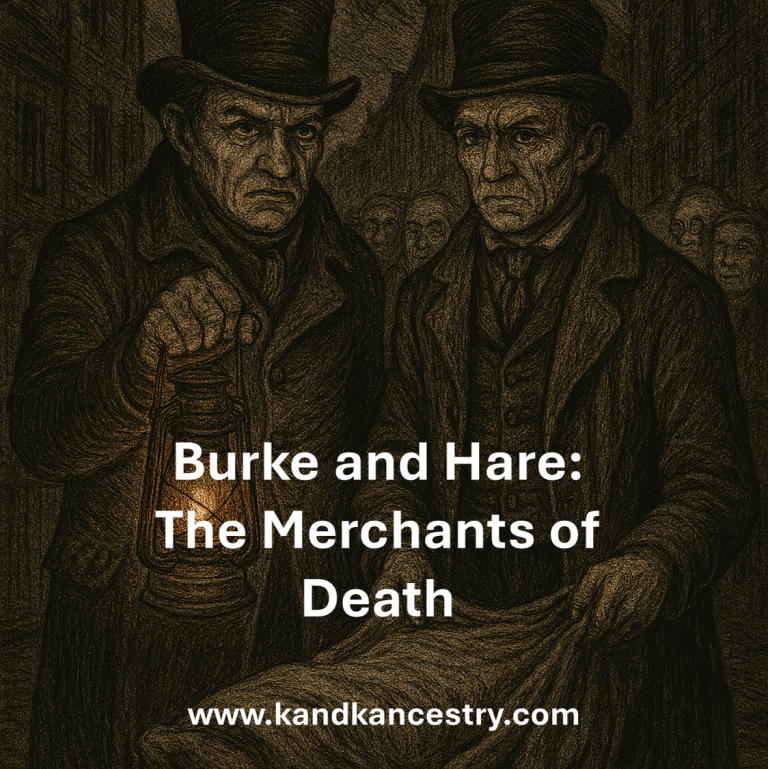
In the shadowy alleys of 19th-century Edinburgh, two names still echo with infamy: William Burke and William Hare. Their story is not just one of murder—it’s a tale of desperation, greed, and the macabre intersection of science and morality.
At the time, Edinburgh was a leading centre for medical education, attracting students from across Europe. Surgeons and anatomists needed cadavers for dissection, but Scottish law only allowed the use of bodies from those who died in prison, suicides, foundlings or orphans. The Judgement of Death Act 1823 drastically reduced the number of executions, which had previously supplied the bulk of cadavers.
This created a booming black market for corpses, and the city became a playground for “resurrection men”—grave robbers who sold stolen bodies to medical schools. Families resorted to guarding graves, and cemeteries installed watch towers to deter theft.
Burke and Hare, Irish immigrants scraping by in the West Port area, saw an opportunity. Hare ran a boarding house and when a lodger named Donald died of natural causes in November 1827, still owing rent, the pair removed his body from the coffin, replacing it with tanning bark. They sold the body to Dr. Robert Knox, a prominent anatomist at Edinburgh University, for £7 10s - a small fortune at the time.
Encouraged by the payout and the ease of the transaction, the pair escalated. Rather than wait for death, they began to manufacture it. Over the course of ten months in 1828, Burke and Hare murdered at least 16 people, targeting the vulnerable: lodgers, beggars, and the elderly. Their method was chillingly efficient - suffocation, often by compressing the chest and covering the mouth, which left no obvious marks for forensic examiners. This technique became known as “Burking.”
Each body was delivered to Knox’s premises in Surgeons’ Square, where assistants welcomed the duo without question. The fresher the corpse, the better for anatomical study—and the higher the price. Knox reportedly praised the quality of the specimens and made no inquiries about their origin, though he later denied knowledge of the murders.
Their spree ended in October 1828 when suspicious lodgers discovered the body of Margaret Docherty hidden under straw in Burke’s home. Hare turned king’s evidence, testifying against Burke in exchange for immunity. Burke was convicted of one murder and hanged in January 1829. In a twist of poetic justice, his body was dissected for medical science. His skeleton remains on display at the Anatomical Museum of Edinburgh Medical School.
The scandal shocked the nation and led to the Anatomy Act of 1832, which allowed legal donation of bodies to science and ended the grisly trade in stolen corpses. It marked a turning point in medical ethics and public trust in science.
Even today, the legacy of Burke and Hare lingers. The graveyard at Old Newton Parish Church in Midlothian - allegedly targeted by the duo - is steeped in local lore, including a musket ball mark said to be from a thwarted body-snatching attempt. The church itself was recently sold, sparking community outrage over the loss of a site so deeply entwined with Scotland’s darker history.