
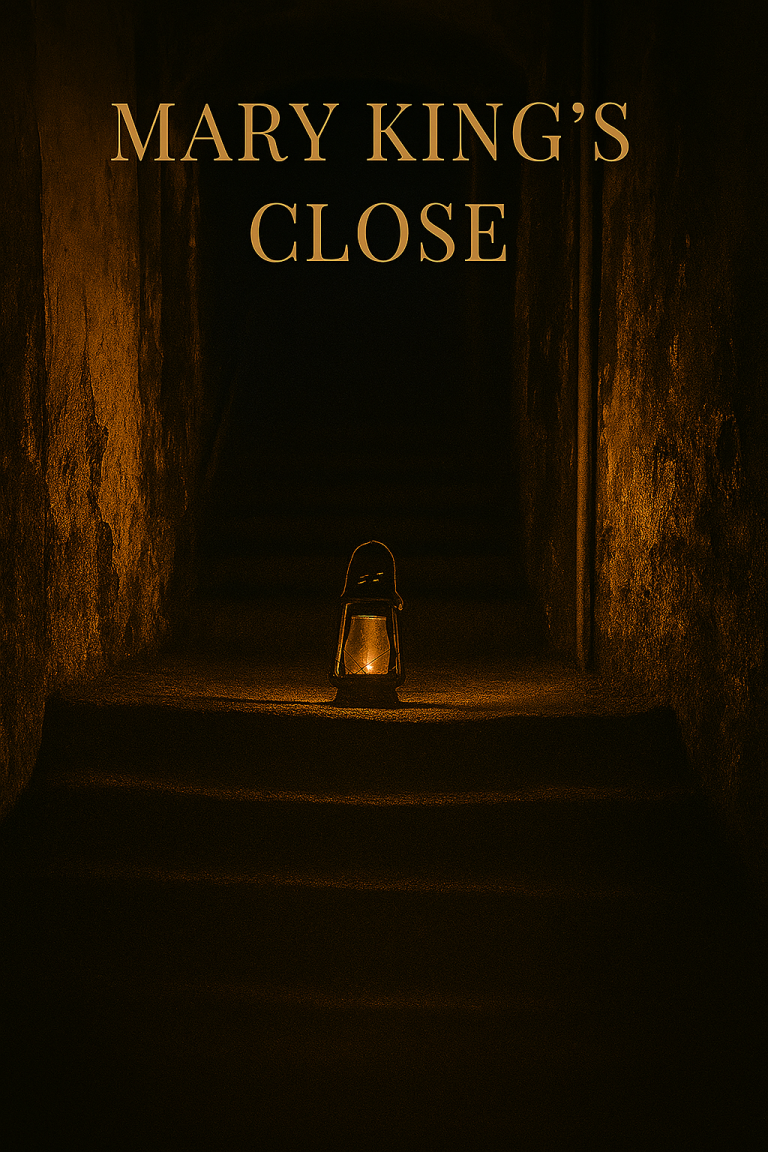
Beneath the Mile: The Haunted Legacy of Mary King’s Close
Originally published 30 October 2025
🕯️ Beneath the Mile: The Haunted Legacy of Mary King’s Close
As Halloween draws near and the air turns crisp, Edinburgh’s Royal Mile hums with history. But beneath its cobbled surface lies a world few see—a buried street steeped in tragedy, resilience, and ghostly lore. This is Mary King’s Close: a place where the past lingers, and the stories refuse to be forgotten.
🏚️ A Street Named for a Woman of Standing
Mary King’s Close takes its name from a 17th-century merchant and burgess, Mary King—a rare example of a woman with civic prominence in early modern Scotland. Her name endures not just in stone, but in the stories that echo through the Close’s shadowed corridors.
In its prime, the Close was a bustling thoroughfare, lined with tall tenements and home to families, tradespeople, and merchants. Edinburgh’s Old Town was hemmed in by defensive walls, so the city grew upward—creating some of the world’s earliest “high-rise” dwellings. The wealthy lived in the upper floors, while the poor occupied the damp, dark lower levels, often sharing space with livestock.
⚰️ The Plague Years: A City in Crisis
In 1645, the bubonic plague swept through Edinburgh. Mary King’s Close, with its cramped quarters and poor sanitation, became a hotspot of infection. Contrary to popular myth, the Close wasn’t sealed with victims inside—but many residents hung white flags from their windows to signal for help.
Enter Dr George Rae, a plague doctor clad in a leather coat and a beaked mask filled with herbs. He braved the Close to treat the sick, draining buboes and cauterizing wounds. Though his efforts saved lives, he was never fully paid for his work—a grim reminder of the era’s harsh realities.
🧱 Entombed by Progress
By the mid-18th century, the Close was partially demolished to make way for the Royal Exchange. Its upper floors were removed, and the remaining buildings became the basement of the new City Chambers. For decades, the Close lay hidden—its stories muffled by stone.
Rediscovered in the 1990s and reopened to the public in 2003, Mary King’s Close now offers guided tours that blend historical insight with whispered legend. Visitors walk the same cobblestones as plague victims, merchants, and mothers—feeling the weight of centuries beneath their feet.
👻 Ghosts of the Close: Gentle Hauntings
Among the most enduring tales is that of Annie, a young girl said to have died during the plague. Her spirit was reportedly contacted by a Japanese psychic in the 1990s, who left her a doll. Since then, visitors have filled Annie’s room with toys and trinkets—a quiet tribute to a child lost to history.
Other stories speak of shadowy figures, sudden chills, and the ghost of Mary King herself. Some speculate that biogas from the old Nor’ Loch may have caused hallucinations, fueling centuries of ghost lore. But whether you believe in spirits or not, the Close’s atmosphere is undeniably evocative.