
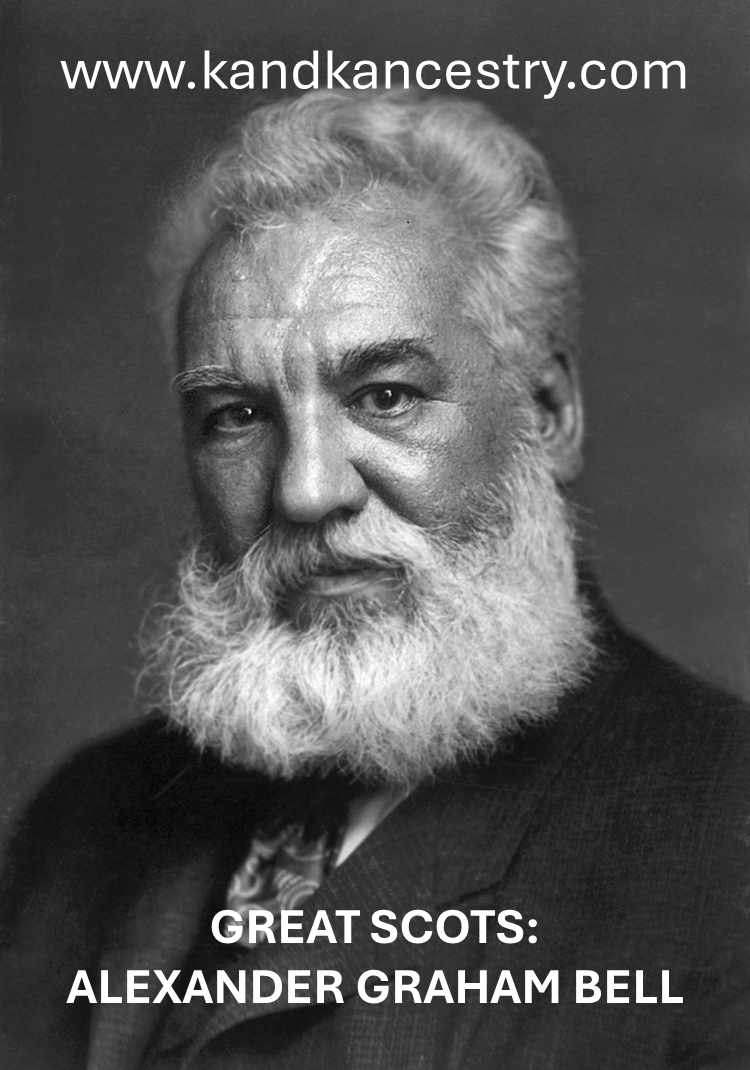
Alexander Graham Bell: The Visionary Who Connected the World
Originally published 13 February 2026
Few individuals have reshaped human communication as profoundly as Alexander Graham Bell. In an age when messages travelled no faster than a horse or a steam engine, Bell dared to imagine a world where the human voice could leap across distance at the speed of electricity. His work didn’t just change technology—it changed the rhythm of daily life, the pace of business, and the way people stayed connected across continents.
A Childhood Immersed in Sound
Born in Edinburgh in 1847, Bell grew up in a household where sound, speech, and the mechanics of communication were everyday conversation. His father, Alexander Melville Bell, was a renowned elocutionist and the creator of Visible Speech, a phonetic system designed to help deaf students learn articulation.
His mother, Eliza, was deaf, and Bell’s early efforts to communicate with her—speaking clearly, enunciating carefully, and even placing his lips against her forehead so she could feel vibrations—shaped his lifelong fascination with acoustics.
This wasn’t simply academic interest. It was personal, emotional, and deeply human. Bell’s later innovations were rooted in empathy as much as engineering.
A Transatlantic Journey and a Growing Curiosity
In the 1870s, the Bell family emigrated to North America, eventually settling in Canada. Alexander soon moved to Boston, where he taught at schools for the deaf and continued experimenting with sound. His work with students—most famously Helen Keller—cemented his reputation as a compassionate educator, but his evenings were spent tinkering with electrical apparatus, driven by a bold idea: transmitting speech over wires.
At the time, the telegraph was the height of communication technology. It could send coded messages, but not the human voice. Bell believed that if multiple tones could be sent simultaneously, perhaps speech itself could be carried.
He wasn’t alone in this race. Inventors across the United States were chasing similar breakthroughs, and the competition was fierce.
14 February 1876: A Patent That Changed the World
The turning point came on 14 February 1876, when Alexander Graham Bell filed his patent application for the telephone. The timing was dramatic—another inventor, Elisha Gray, submitted a similar idea on the very same day. But Bell’s application reached the patent office first, securing him the legal foundation for what would become one of the most important inventions in history.
Just weeks later, on 10 March 1876, Bell achieved the breakthrough he had been striving toward. In a moment now etched into technological lore, he called out:
"Mr Watson - come here - I want to see you."
His assistant, Thomas Watson, heard the words clearly through the device. For the first time, the human voice had travelled electrically from one room to another.
The telephone had been born.
A Relentless Innovator Beyond the Telephone
Although the telephone defined his legacy, Bell’s curiosity was far broader. He explored early aviation, experimented with hydrofoils, and even worked on medical devices. He co‑founded the National Geographic Society, helping shape it into a global platform for science and exploration. Bell was not a one‑invention man—he was a restless thinker who moved easily between disciplines.
A Legacy That Still Resonates
Today, in a world of smartphones, video calls, and instant messaging, it’s easy to forget how revolutionary Bell’s achievement was. His work collapsed distances, connected families, accelerated commerce, and laid the groundwork for the digital networks we rely on every day.
On that February day in 1876, Bell wasn’t simply filing paperwork. He was opening the door to a new era—one where voices could travel farther than footsteps, and human connection could transcend geography.
His legacy continues to ring through every call we make.