
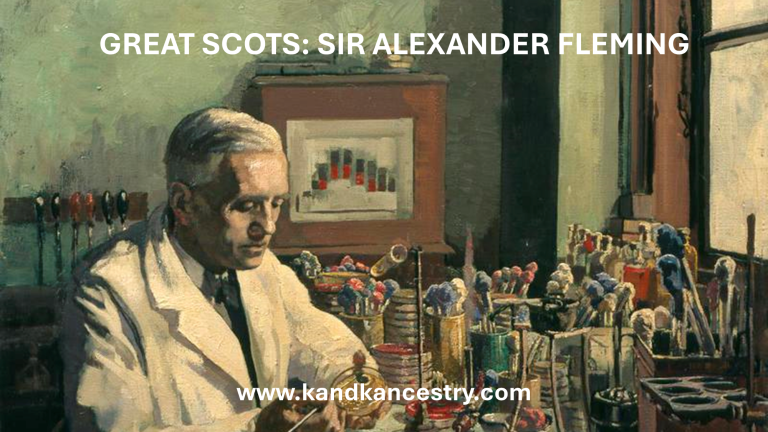
Alexander Fleming: The Scottish Scientist Who Discovered Penicillin
Originally published 28 September 2025
ON THIS DAY – 28TH SEPTEMBER 1928
On 28th September 1928, Alexander Fleming discovered penicillin. Born near Darvel, Ayrshire on 6th August 1881, Fleming was the son of a Scottish farmer. His formative years in rural Scotland fostered curiosity and resilience, traits that would influence his scientific career. He received his early education at Loudoun Moor School and Kilmarnock Academy before relocating to London, where he pursued studies at St Mary’s Hospital Medical School. It was there that he made his groundbreaking discovery.
During research on staphylococcal bacteria in September 1928, Fleming observed that a mold—later identified as Penicillium notatum—had contaminated a petri dish and destroyed the surrounding bacteria. This observation eventually led to the development of penicillin, marking the advent of the world’s first true antibiotic. The path from discovery to widespread use involved several years of refinement and was accelerated by global conflict during the Second World War.
By the 1940s, penicillin was instrumental in saving lives both on the battlefield and in hospitals worldwide.
Fleming was knighted in 1944 and awarded the Nobel Prize in Physiology or Medicine in 1945, sharing the honour with Howard Florey and Ernst Chain. Despite his accolades, Fleming remained modest and emphasised caution regarding antibiotic misuse and the risk of resistance.
Fleming's legacy is significant—not only scientifically but also for its impact on public health, giving hope to countless individuals affected by infection. Today, the Alexander Fleming Laboratory Museum at St. Mary's Hospital, Paddington, preserves the setting of his pioneering work. In 1966, the origin of the fungal contaminant was traced to La Touche's room, located below Fleming's laboratory.
Fleming’s journey from Ayrshire to international recognition exemplifies dedication, humility, and inquiry. He died of a heart attack at his home in London on 11 March 1955, and his ashes are interred at St Paul’s Cathedral.