
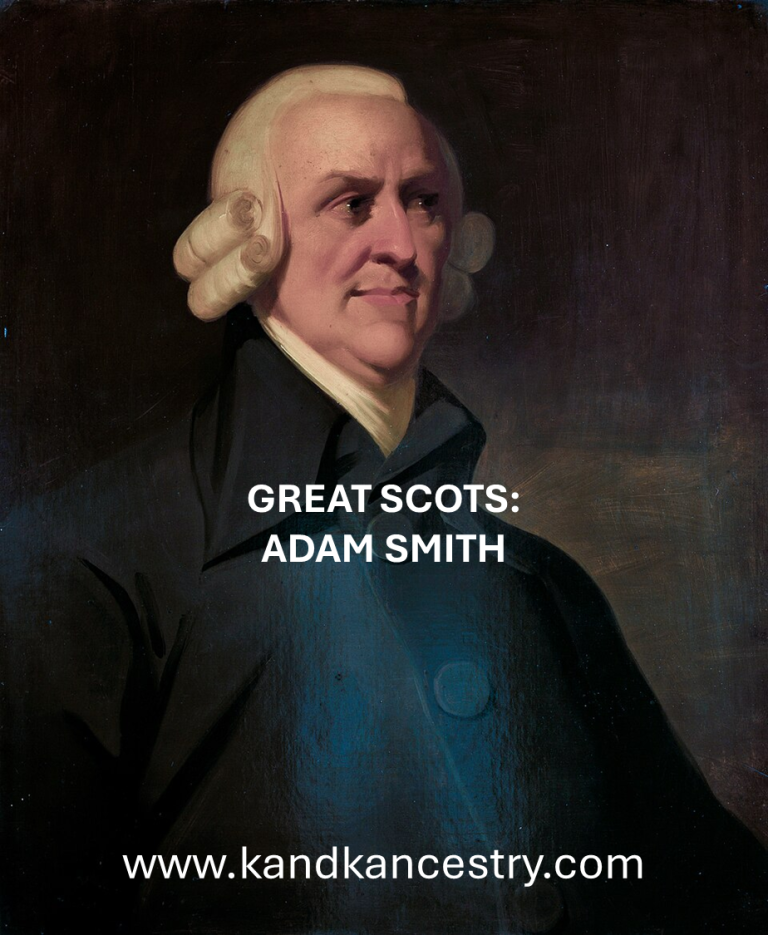
Adam Smith: The Philosopher Who Rewrote How We Understand Society
Originally published 8 March 2026
Few thinkers have shaped the modern world as profoundly as Adam Smith, the Scottish philosopher whose ideas continue to influence economics, politics, ethics, and everyday life. Born in 1723 in Kirkcaldy, Smith lived during the Scottish Enlightenment — a period of remarkable intellectual energy that produced some of history’s most original minds. Yet what makes Smith so compelling isn’t just his brilliance; it’s the humanity at the heart of his work.
A Philosopher Before an Economist
Although Adam Smith is often called “the father of economics,” he never saw himself in such narrow terms. His first major book, The Theory of Moral Sentiments (1759), wasn’t about markets or money — it was about human nature.
Smith believed that people are not driven solely by self‑interest. Instead, he argued that we are deeply social creatures, guided by empathy, imagination, and what he called the “impartial spectator” — an inner voice that helps us judge right from wrong.
This moral foundation is essential to understanding Smith. For him, society works best when individuals act with a sense of responsibility, fairness, and mutual respect.
Smith the Teacher: Lecturer, Professor, and Travelling Tutor
Before he became a world‑famous author, Adam Smith spent much of his life as a teacher — and it was in the classroom that many of his ideas first took shape.
- Early Lectures in Edinburgh
In the 1740s, Smith delivered a series of public lectures in Edinburgh on rhetoric, literature, and the principles of law and society. These talks were so well received that they helped launch his academic career.
- Professor at the University of Glasgow
In 1751, Smith was appointed Professor of Logic at the University of Glasgow, and a year later he became Professor of Moral Philosophy — one of the most prestigious academic posts in Scotland.
At Glasgow, he taught:
- ethics
- jurisprudence
- political economy
- rhetoric and belles lettres
His lectures were famous for their clarity, warmth, and intellectual depth. Students travelled from across Britain and Ireland to study under him, and many later credited Smith with shaping their understanding of the world.
- Tutor to the Duke of Buccleuch
In 1764, Smith accepted a highly influential role as private tutor to the young Duke of Buccleuch. This position took him on a grand tour of France, Switzerland, and beyond, where he met leading Enlightenment thinkers such as Voltaire, Turgot, and Quesnay.
These travels exposed Smith to new political systems, economic models, and philosophical debates — experiences that profoundly shaped the ideas he would later develop in The Wealth of Nations.
The Wealth of Nations: A New Way of Seeing the World
On 9th March 1776, Smith published An Inquiry into the Nature and Causes of the Wealth of Nations, the book that transformed him into a global intellectual force. Here, he explored how societies grow prosperous, why some nations thrive while others stagnate, and how ordinary people can improve their lives through work, trade, and innovation.
Some of his most famous ideas include:
- Division of Labour
Smith observed that breaking work into specialised tasks dramatically increases productivity. His example of a pin factory — where workers each perform a single step — remains a classic illustration of efficiency.
- The Invisible Hand
Perhaps his most misunderstood concept, the “invisible hand” describes how individuals pursuing their own goals can unintentionally benefit society. But Smith never meant this as a free‑for‑all; he believed markets require rules, justice, and moral behaviour to function well.
- Free Trade and Open Markets
Smith argued that nations prosper when they trade freely, allowing each to specialise in what they do best. This idea laid the groundwork for modern global economics.
A Thinker Grounded in Humanity
What sets Smith apart from many later economists is his insistence that economic life cannot be separated from moral life. He believed:
- Wealth should improve the lives of ordinary people
- Governments have a duty to protect the vulnerable
- Education is essential for a healthy society
- Markets must operate within a framework of justice
In other words, Smith’s vision was not cold or mechanical — it was deeply human.
Legacy: Why Adam Smith Still Matters
Today, Adam Smith’s ideas remain central to debates about:
- how to balance markets and regulation
- the role of government in society
- globalisation and trade
- fairness, inequality, and opportunity
But perhaps his greatest legacy is his belief that progress is possible — that societies can grow more prosperous, more just, and more humane through thoughtful action and shared responsibility.
A Scottish Voice with Global Impact
From the cobbled streets of Kirkcaldy to the lecture halls of Glasgow and the salons of Paris, Adam Smith’s influence stretches across centuries. He was not just a theorist of wealth but a philosopher of human behaviour, empathy, and social harmony.
In a world still wrestling with questions of fairness, prosperity, and moral responsibility, Smith’s work feels as relevant as ever.